【引言】
每到玉米秋收季,大量玉米芯集中产出,成为玉米产区农副加工企业、种植大户面临的一大难题。玉米芯产量大、产出周期短,原生物料含水率居高不下,质地疏松多孔,极易回潮吸潮。一旦存储不当,短短时间内就会发霉变质、滋生霉菌与虫害,不仅占用大片场地,还会造成生物质资源大量浪费。传统晾晒与普通烘干设备很难稳定处理这类轻质物料,大量玉米芯只能低价贱卖甚至直接废弃,资源价值白白流失。金万泓玉米芯专用烘干机,针对玉米芯疏松轻质的物料特性量身打造,梯度低温烘干,保色保品质,把原本容易腐烂的玉米芯,转化成多渠道可销售的高附加值原料。
Every corn harvest season, massive volumes of corn cobs are produced in a short window, creating a major headache for agricultural by-product processors and large-scale growers in corn-growing regions. Corn cobs are produced in huge quantities within a tight harvest period. Raw cobs retain high moisture content; their loose, porous structure readily absorbs moisture and reabsorbs humidity. Improper storage quickly leads to mildew and spoilage, mould and pest infestations. Not only do they occupy large storage areas, but substantial biomass resources are also wasted. Natural sun-drying and conventional drying equipment struggle to stably process such lightweight materials. Large amounts of corn cobs can only be sold at rock-bottom prices or discarded outright, throwing away their resource value.
The Jinwanhong special corn cob dryer is tailor-made for the loose, lightweight characteristics of corn cobs. It adopts gradient low-temperature drying to preserve colour and quality, turning perishable raw corn cobs into high-value feedstock saleable through multiple channels.
一、玉米芯处理核心痛点:秋收集中产出,存储难题突出
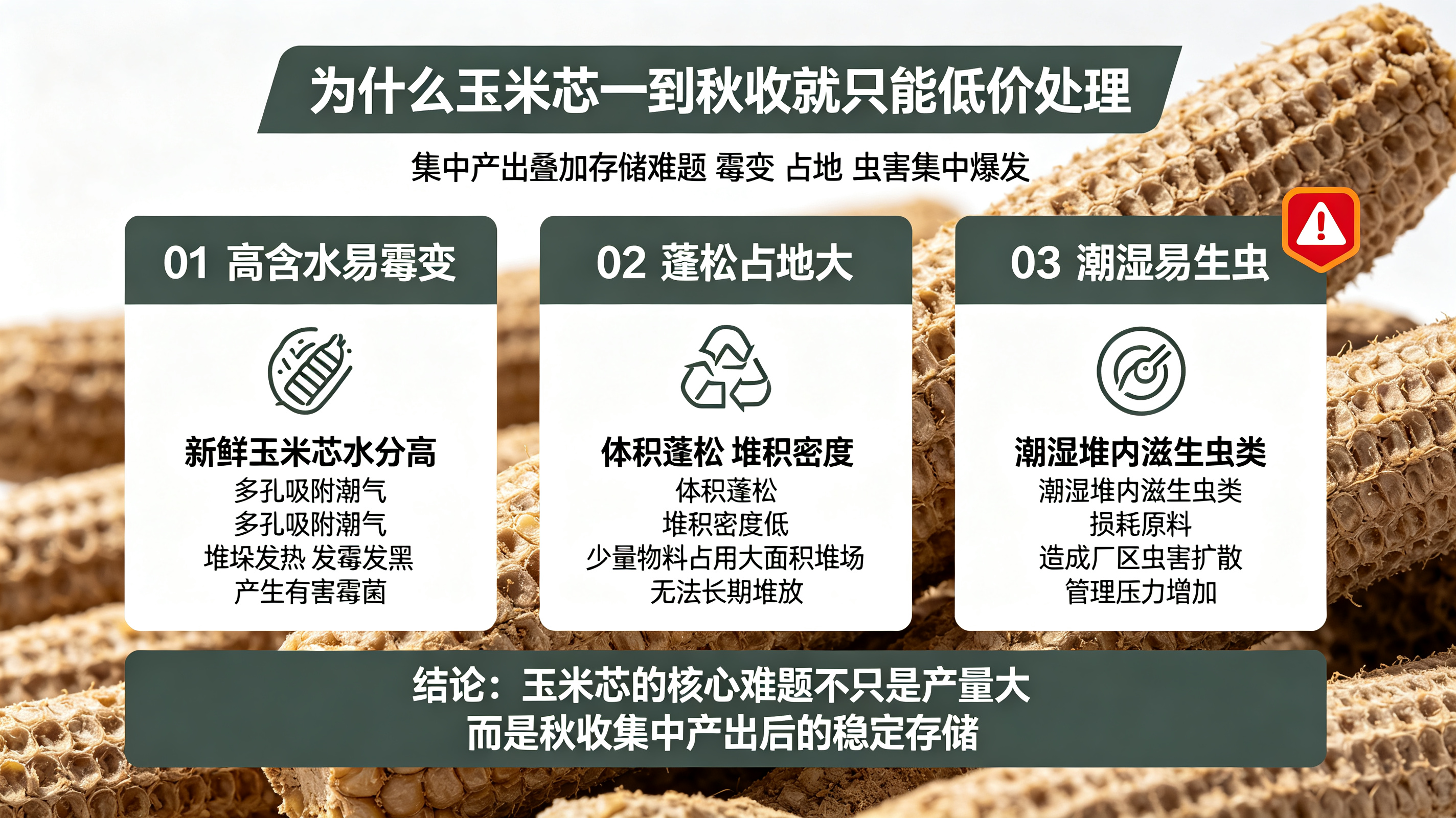
玉米芯属于典型农林生物质固废,秋收时段短时间集中产出,物料处理压力集中爆发,痛点十分突出:
1.原生含水率高,极易霉变腐烂 刚剥离的新鲜玉米芯水分含量高,多孔结构极易吸附空气中潮气,堆垛内部发热,快速发霉发黑,产生有害霉菌,物料直接报废。
2.占地规模大,挤占生产场地 玉米芯体积蓬松、堆积密度低,少量物料就要占用大面积堆场,很多加工厂、产业园场地紧张,无法长期堆放大量原料。
3.虫害风险高 潮湿玉米芯堆内极易滋生各类虫类,不仅损耗原料,还容易造成厂区虫害扩散,增加厂区管理压力。大量玉米芯因为存储难题,只能低价处理,资源价值无法释放。
I. Core Pain Points of Corn Cob Treatment: Concentrated Harvest Output and Severe Storage Difficulties
Corn cobs are typical agricultural and forestry biomass solid waste. Production surges sharply during the short harvest window and creates intense material-handling pressure with prominent challenges:
High raw moisture content and high risk of mildew and rot Freshly stripped corn cobs have high moisture levels. Their porous structure easily absorbs ambient moisture. Heat builds up inside stacked piles, causing rapid blackening and mould growth with harmful fungi, rendering the material unusable.
Large footprint and occupied production space Corn cobs are fluffy with low bulk density. Even a small volume takes up a large stacking area. Many processing plants and industrial parks face space shortages and cannot stockpile large quantities of raw material long-term.
High pest risk Wet corn cob piles easily breed various insects, damaging raw materials and triggering pest spread across the plant, increasing site management burdens.
Due to storage limitations, large quantities of corn cobs have to be disposed of cheaply, and their resource value cannot be realised.
二、传统处理方式弊端重重,难以满足工业化加工需求
很多农户和农副加工厂,依旧沿用自然晾晒方式处理玉米芯,局限性非常明显:
✅ 自然晾晒高度依赖天气,秋收季节雨水多、昼夜温差大,遇到连续阴雨天,玉米芯根本无法摊开晾晒,物料只能积压腐烂;
✅ 人工晾晒需要大面积晒场,投入大量人工翻料,人力成本逐年上涨;
✅ 晾晒成品含水率波动大,干湿不均匀,达不到食用菌基质、生物质原料的工业化收购标准,收购方压价严重;
✅ 晾晒过程扬尘大,粉尘管控难度高,环保管控压力大。
单纯依靠晾晒,只能作为临时简易处理手段,无法稳定、规模化产出达标原料。
II. Drawbacks of Traditional Treatment Methods, Inadequate for Industrial Processing
Many farmers and agricultural by-product processors still rely on natural sun-drying for corn cobs, which carries obvious limitations:
✅ Heavily weather-dependent. Harvest season often brings heavy rain and large day-night temperature swings. Continuous rainy weather makes spreading and drying impossible, leading to stockpiling and rot.
✅ Sun-drying requires extensive open yards and heavy manual labour for material turning, with labour costs rising year after year.
✅ Wide moisture fluctuations and uneven drying of sun-dried products, failing industrial purchasing standards for mushroom substrate and biomass feedstock. Buyers substantially cut prices.
✅ Severe dust generation during drying, difficult dust control and heavy environmental compliance pressure.
Sun-drying can only serve as a simple temporary solution and cannot stably produce large volumes of qualified raw materials at scale.
三、传统烘干设备通病:适配性不足,飘料焦糊问题频发
不少企业尝试使用通用烘干设备处理玉米芯,但是玉米芯轻质、蓬松、易破碎的物料特性,和常规烘干设备并不匹配,投产之后问题接连不断:
1.飘料、跑料严重:轻质玉米芯容易被热风裹挟带走,物料损耗大,收料率低,原料浪费严重;
2.烘干不均匀:物料容易结团,外层烘干干透,内部依然潮湿,成品含水率波动大;
3.局部高温焦糊碳化:玉米芯有机质含量高,局部温度过高极易焦糊发黑,破坏物料品质,无法用于食用菌栽培等高附加值场景;
4.成品品质不稳定:批次之间品质差异大,下游收购商拒收或者大幅压价,资源化收益大打折扣。
通用烘干设备是“一刀切” 设计,没有针对轻质农林物料优化,处理玉米芯往往得不偿失。
III. Common Defects of Conventional Dryers: Poor Adaptability, Material Carry-over and Scorching
Many enterprises try general-purpose drying equipment for corn cobs. However, corn cobs’ lightweight, fluffy and fragile traits do not match standard dryers, resulting in a string of operational issues after commissioning:
Severe material carry-over and loss: Lightweight corn cobs are easily swept away by hot air flow, causing high material loss, low recovery rates and serious raw material waste.
Uneven drying: Material tends to clump; outer layers become fully dried while the inner mass remains damp, leading to unstable moisture in finished products.
Local overheating, scorching and carbonisation: Corn cobs are rich in organic matter. Local high temperatures easily cause black scorching, degrading material quality and disqualifying it for high-value applications such as mushroom cultivation.
Unstable finished quality: Large quality variations across batches, leading to rejection or heavy price cuts by downstream purchasers and sharply reduced revenue from resource utilisation.
General dryers adopt a one-size-fits-all design without optimisation for lightweight agricultural and forestry materials, making corn cob processing often uneconomical.
四、金万泓玉米芯专属烘干工艺:循环梯度热风,平稳脱水不毁料
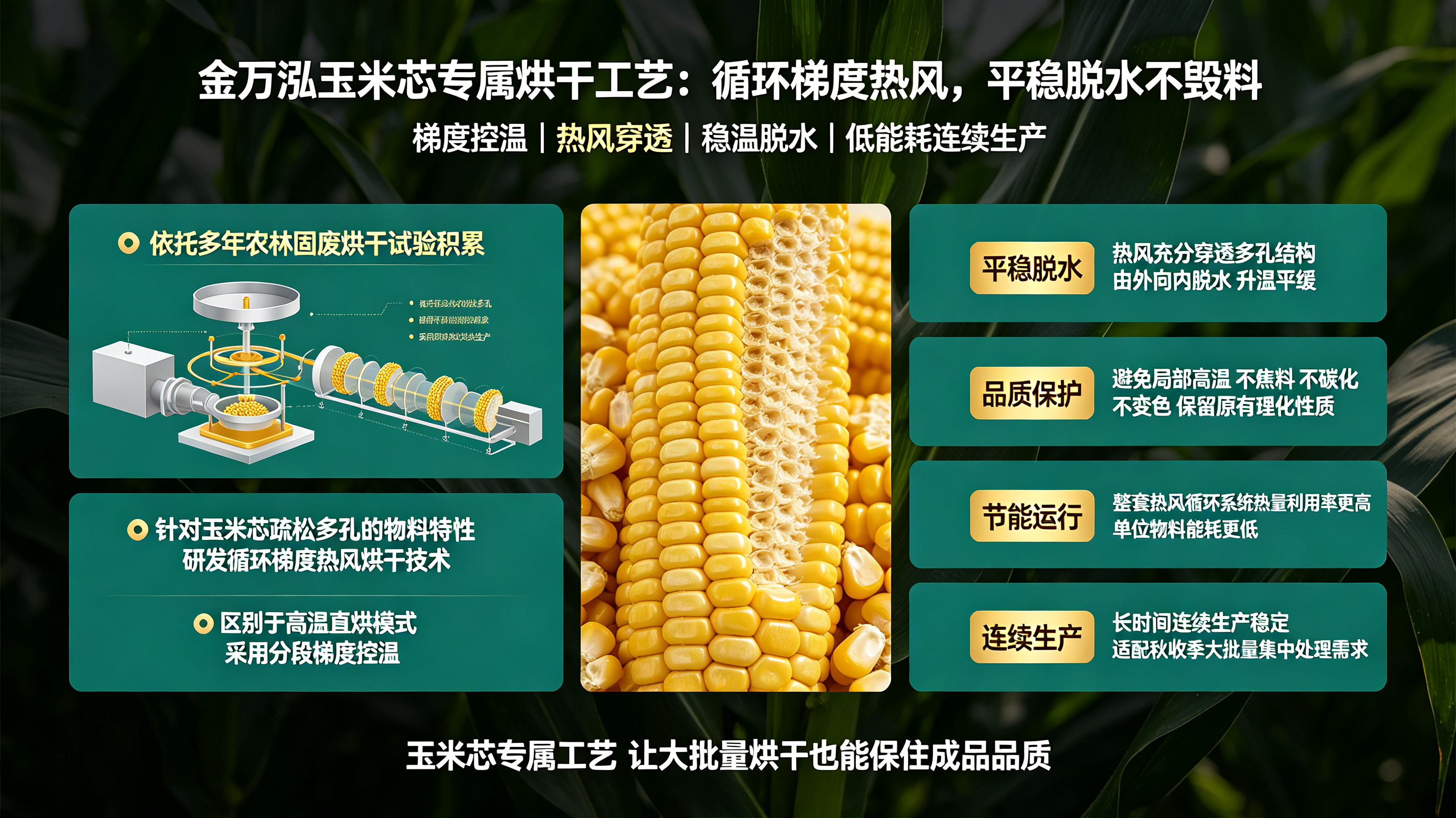
金万泓依托多年农林固废烘干试验积累,针对玉米芯疏松多孔的物料特性,研发循环梯度热风烘干技术。区别于高温直烘模式,采用分段梯度控温,热风能够充分穿透玉米芯多孔结构,由外向内平稳脱水。烘干全程温度可控,升温平缓,避免局部高温,做到不焦料、不碳化、不变色,最大程度保留玉米芯原有理化性质,保障成品品质。整套热风循环系统热量利用率更高,单位物料能耗更低,长时间连续生产工况下运行稳定,适配秋收季大批量集中处理需求。
IV. Jinwanhong Specialised Corn Cob Drying Technology: Circulating Gradient Hot Air for Gentle Dewatering Without Damaging Material
Drawing on years of R&D and testing experience in drying agricultural and forestry solid waste, Jinwanhong has developed circulating gradient hot-air drying technology adapted to corn cobs’ porous, loose structure.
Unlike direct high-temperature drying, segmented gradient temperature control is applied. Hot air fully penetrates the porous structure of corn cobs and removes moisture steadily from outside in. Temperature stays controllable throughout drying with mild heating, avoiding local overheating. No scorching, carbonisation or discolouration occurs. The original physical and chemical properties of corn cobs are preserved to maximise finished product quality.
The full hot-air circulation system delivers higher heat utilisation and lower energy consumption per unit of material. It runs stably under long continuous production and meets demand for bulk concentrated processing during harvest season.
五、专属结构优化设计,解决轻质物料结团飘料难题
在设备结构上做针对性定制优化,专门攻克玉米芯轻质物料的行业难题:
·定制防飘料、防缠绕结构,控制热风风速,避免轻质玉米芯被气流带走,降低物料损耗;
·分层扬料打散结构,持续打散结团物料,物料充分分散,消除烘干死角;
·可控出料系统,成品含水率稳定可调,干湿均匀,每一批次物料品质统一。经过设备处理后的玉米芯,色泽均匀,含水率稳定可控,满足下游各类深加工原料标准。
V. Customised Structural Optimisation to Resolve Clumping and Airborne Material Loss for Lightweight Feedstock
Targeted custom structural upgrades tackle industry challenges specific to lightweight corn cob materials:
Custom anti-carryover and anti-tangling structure; hot-air velocity controlled to prevent lightweight corn cobs from being swept away by airflow and reduce material loss.
Layered material lifting and breaking structure to continuously break clumps, fully disperse material and eliminate drying dead zones.
Controllable discharging system with stable, adjustable moisture content and uniform dryness; consistent quality batch after batch.
Corn cobs processed by this machine have uniform colour and stable, adjustable moisture, satisfying downstream standards for various deep-processing raw materials.
六、玉米芯多元资源化用途,一条设备打开多重增收渠道
烘干达标后的玉米芯,摆脱了易霉变难储存的短板,附加值大幅提升,应用场景十分丰富:
✅ 食用菌栽培基质:是蘑菇、香菇等菌类优质栽培原料,市场需求量稳定;
✅ 动物饲料辅料:经过预处理后,可作为牛羊等畜禽饲料填充原料;
✅ 生物质燃料:作为生物质锅炉燃料,清洁燃烧,适配能源企业;
✅ 糠醛、木糖醇工业原料:供给化工企业深加工;
✅ 园艺育苗基质:用于花卉、苗木育苗基质,园艺市场需求持续增长。
一套玉米芯烘干设备,实现原料多渠道销售,企业可以根据市场行情灵活切换销路,规避单一市场价格波动风险。
VI. Diversified Resource Utilisation of Dried Corn Cobs: One Machine Opens Multiple Revenue Streams
Once dried to standards, corn cobs lose their tendency to mildew and become hard to store, greatly boosting added value with a wide range of applications:
✅ Mushroom cultivation substrate: Premium raw material for growing mushrooms, shiitake and other fungi with stable market demand.
✅ Animal feed additive: After pre-treatment, usable as filler for cattle, sheep and other livestock feed.
✅ Biomass fuel: Fuel for biomass boilers for clean combustion, suitable for energy enterprises.
✅ Industrial raw material for furfural and xylitol: Supplied to chemical manufacturers for deep processing.
✅ Horticultural seedling substrate: For flower and seedling cultivation; demand in the horticulture market keeps growing.
A single corn cob drying line enables multi-channel sales. Operators can flexibly switch sales outlets according to market conditions and hedge against price volatility risks of a single market.
七、全场景适配与政策适配,享受农林固废资源化红利
金万泓玉米芯专用烘干机适配多类经营主体:玉米主产区种植大户、粮食加工厂、农副产业园、生物质能源企业,可根据客户日处理量定制机型,支持中小型单机到大型成套生产线。设备节能低耗,配套除尘系统,环保指标达标,符合农林废弃物资源化利用项目要求。项目可对接地方农林固废专项扶持资金,符合申报条件的主体,可申领对应的设备补贴,降低项目投入成本。
VII. Full-scenario and Policy Adaptability: Capture Benefits from Agricultural Waste Recycling
Jinwanhong corn cob dedicated dryers suit many types of operators: large corn-belt growers, grain processing plants, agricultural by-product industrial parks and biomass energy companies. Models can be customised according to daily throughput, ranging from small and medium standalone units to large complete production lines.
The equipment features low energy consumption and is fitted with dust removal systems to meet environmental standards. It complies with requirements for agricultural and forestry waste resource utilisation projects. Projects can apply for special local subsidies for agricultural solid waste recycling. Qualified applicants may receive equipment subsidies to cut project investment costs.
结语
玉米芯本身是极具价值的农林生物质资源,只是受含水率、存储条件限制,大量资源被浪费。传统晾晒、通用烘干设备无法释放它的价值。金万泓玉米芯专用烘干机,依靠梯度热风工艺与防飘料专属结构,稳定产出高品质烘干玉米芯,打通食用菌基质、饲料、生物质燃料等多条变现路径。秋收旺季集中处理,解决原料霉变、占地难题,把废弃玉米芯变成稳定增收的优质原料,助力农副企业实现农林固废资源化循环利用。
如果你有玉米芯烘干项目规划,想要来料试烘、评估产能与项目补贴,欢迎联系金万泓机械,获取定制化烘干方案。
Corn cobs are highly valuable agricultural biomass resources. Yet limited by high moisture and storage conditions, large volumes go to waste. Sun-drying and general drying equipment cannot unlock their full value.
Jinwanhong special corn cob dryers leverage gradient hot-air technology and proprietary anti-carryover structures to consistently produce high-quality dried corn cobs. Multiple monetisation channels are opened for mushroom substrate, feed, biomass fuel and more.
Bulk processing during the harvest peak solves mildew and space occupation issues, turning waste corn cobs into high-quality raw materials for steady revenue and supporting agricultural enterprises in circular recycling of agricultural and forestry solid waste.
If you are planning a corn cob drying project and would like test drying, capacity evaluation and subsidy assessment, contact Jinwanhong Machinery for a custom drying solution.