【引言】
2026 年,畜禽粪污资源化利用、农林废弃物综合处置、无废乡村建设持续加码。烘干装备作为农牧固废资源化链条的核心硬件,正式纳入农业农村、生态环境部门标准化配套清单。一边是环保常态化督查收紧,老旧设备淘汰提速;另一边是技改补贴、税收优惠等政策红利集中释放。不少养殖场、农副加工企业苦于看不懂政策标准,要么设备选型不合规无法申报补贴,要么错失申报窗口期白白浪费扶持资金。
本文系统梳理2026 年烘干相关新政、设备硬性标准、各类补贴细则、财税优惠,搭配申报避坑要点与落地案例,帮企业选对合规设备、吃透政策红利,实现合规生产、降本增收。
In 2026, policies for the resource utilisation of livestock and poultry manure, comprehensive disposal of agricultural and forestry waste, and zero-waste village development will continue to be strengthened. As core hardware within the agricultural and pastoral solid waste resource recovery chain, drying equipment has been formally included on the standard supporting equipment list of agricultural, rural and ecological environment authorities. On one hand, routine environmental inspections are tightening and the phase-out of outdated equipment is accelerating. On the other hand, policy dividends such as technical renovation subsidies and tax incentives are being rolled out intensively. Many breeding farms and agricultural by-product processors struggle to interpret policy standards. They either select non-compliant equipment and become ineligible for subsidies, or miss application windows and forfeit available financial support.
This article systematically sorts out new 2026 drying-related policies, mandatory equipment standards, detailed subsidy rules and fiscal & tax incentives. It also includes key pitfalls to avoid during applications and real implementation cases, helping enterprises select compliant equipment, fully capture policy benefits, achieve compliant production and cut costs while boosting revenue.
一、2026 行业政策大趋势:固废烘干设备纳入标准化合规配套清单
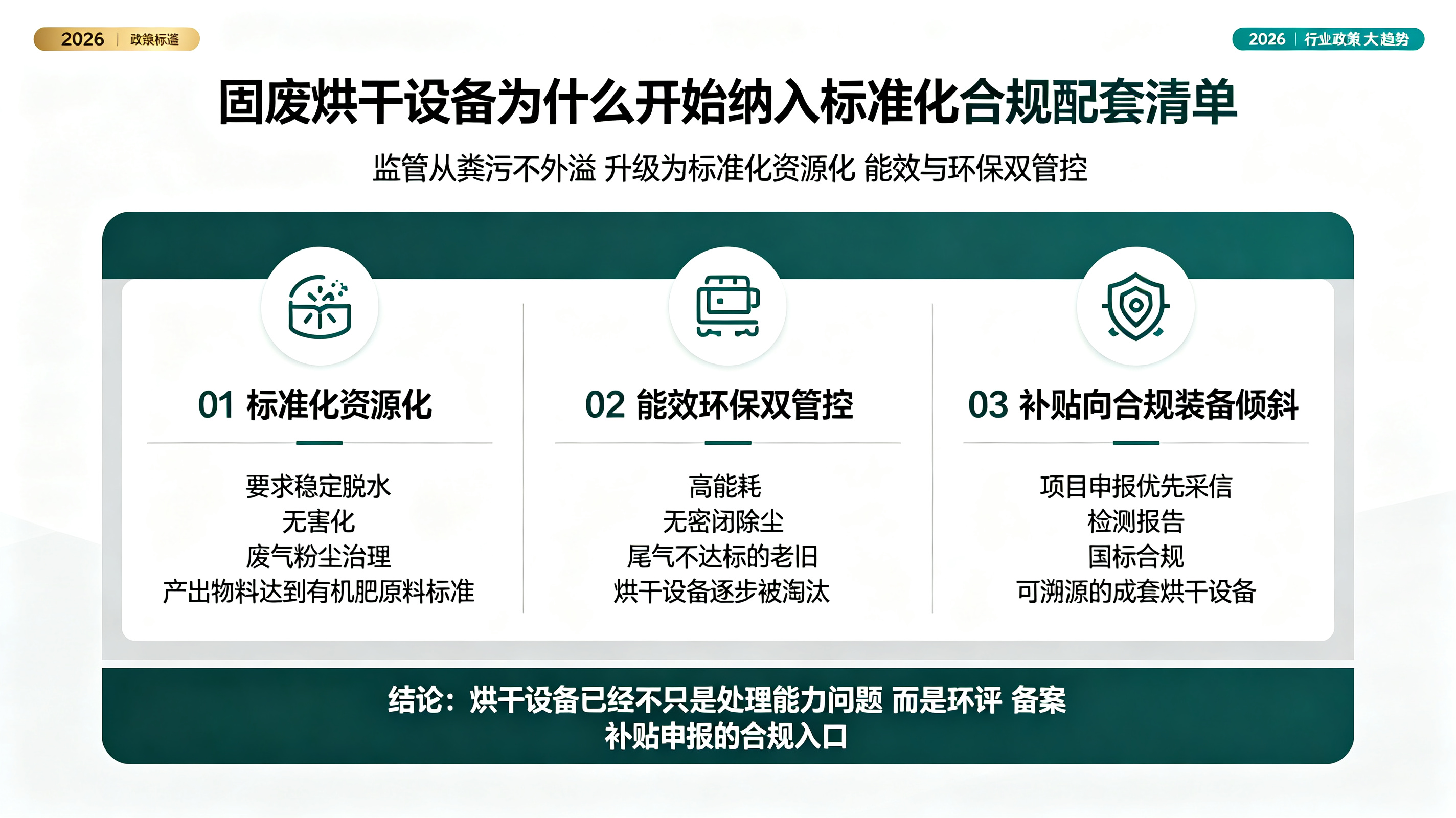
国家持续推动种养循环、无废农业建设,畜禽粪污、秸秆、玉米芯等农林废弃物不再简单堆放还田,鼓励通过烘干预处理实现减量化、无害化、资源化。烘干设备作为固废处理核心配套装备,监管导向发生明显转变:
1.由“简单处置” 转向标准化资源化:不再只满足粪污不外溢,要求配套设备具备稳定脱水、无害化、废气粉尘治理能力,产出物料达到有机肥原料标准;
2.能效与环保双管控:高能耗、无密闭除尘、尾气不达标的老旧烘干设备,被纳入逐步淘汰清单;
3.补贴资金向合规装备倾斜:各地项目申报优先采信具备完整检测报告、符合国标、可溯源的成套烘干设备,通用简易设备很难拿到专项扶持资金。
无论是规模化养殖场、农林加工企业,还是区域性粪污集中处理中心,烘干产线的合规性,直接决定环评验收、项目备案、补贴申报能否顺利通过。
I. Major Industry Policy Trends in 2026: Solid Waste Drying Equipment Added to Standard Compliance Supporting List
China continues to promote crop-livestock cycling and zero-waste agriculture. Livestock manure, straw, corn cobs and other agricultural and forestry waste can no longer simply be stockpiled and returned to farmland. Pre-treatment via drying is encouraged to realise waste reduction, harmless treatment and resource utilisation. The regulatory approach for drying equipment as core solid waste treatment facilities has undergone a clear shift:
Shift from “simple disposal” to standardised resource utilisation: The requirement is no longer merely to prevent manure runoff. Supporting equipment must deliver stable dewatering, harmless treatment, and exhaust and dust control, and produce materials meeting organic fertiliser feedstock standards.
Dual control of energy efficiency and environmental performance: Old drying equipment with high energy consumption, no enclosed dust removal and substandard tail gas is being phased out.
Subsidy funding tilted toward compliant equipment: Project applications across regions give priority to complete drying production lines with full test reports, national standard compliance and traceability. Generic simple equipment rarely qualifies for special funding.
For large-scale breeding farms, agricultural and forestry processing enterprises and regional centralised manure treatment centres, compliance of drying lines directly determines the success of EIA acceptance, project filing and subsidy applications.
二、最新设备合规硬性标准:能效、排放、无害化指标全面更新
2026 年工业烘干机能效新标准、粉尘废气排放新规、农牧固废无害化指标同步落地,对烘干设备提出三大硬性门槛,不达标的老旧设备面临限期改造:
✅ 能效指标:新版工业烘干机能效限定值正式实施,淘汰热效率低、热量损耗大的老式滚筒设备,单位物料能耗必须达到国标限定范围;
✅ 废气粉尘排放:烘干过程产生的粉尘、恶臭气体必须配套密闭收集+ 除尘除臭系统,无组织逸散将直接判定环保不合格;
✅ 无害化指标:畜禽粪污烘干设备,必须配套高温灭菌工艺,杀灭虫卵、致病菌,成品无害化指标满足有机肥原料相关规范。
简单来说,只具备单纯脱水功能、无密闭结构、无高温无害化能力的简易烘干设备,在2026 年环评核查、项目验收中将不再认可。
II. Updated Mandatory Equipment Compliance Standards: Full Revisions to Energy Efficiency, Emission and Harmlessness Indicators
The 2026 new national standard for energy efficiency of industrial dryers, new rules on dust and odour emissions, and updated harmlessness indicators for agricultural solid waste are taking effect simultaneously. Drying equipment must meet three mandatory thresholds; outdated non-compliant units face mandatory renovation deadlines: ✅ Energy efficiency indicators: The new limit values for industrial dryer energy efficiency are enforced. Old rotary drum dryers with low thermal efficiency and high heat loss are phased out. Energy consumption per unit of material must fall within national standard limits. ✅ Dust and waste gas emissions: Dust and malodorous gas generated during drying must be equipped with enclosed collection plus dust and odour removal systems. Unorganised emissions will be directly judged as environmental non-compliance. ✅ Harmlessness indicators: Drying equipment for livestock manure must integrate high-temperature sterilisation technology to kill parasite eggs and pathogenic bacteria. Harmlessness indicators of finished products must meet specifications for organic fertiliser raw materials.
Simply put, simple drying equipment with only dewatering function, no enclosed structure and no high-temperature harmless treatment capability will no longer be recognised during EIA inspections and project acceptance in 2026.
三、养殖粪污烘干专项补贴:新建、技改、集中处理中心分级扶持
当前畜禽粪污资源化项目补贴多执行先建后补、验收拨付模式,不同场景申报门槛、补贴比例、封顶金额存在地域差异:
1.规模化养殖场新建粪污烘干项目补贴 存栏达到申报门槛的蛋鸡、肉鸡、肉牛养殖场,配套新建粪污烘干资源化生产线,可申报畜禽粪污资源化利用专项资金,多数地区补贴比例为设备投资额20%-30%,单个项目设置补贴封顶额度。
2.老旧烘干设备技改升级补贴 针对原有老旧烘干设备节能改造、环保升级项目,纳入农牧装备技改专项,适合原有设备堵料、能耗高、环保不达标的养殖场,原位技改项目同样可参与申报。
3.粪污集中处理中心专项奖励 县域、乡镇级粪污集中处置中心,建设规模化烘干生产线,可申报更高层级中央预算内涉农资金,支持固废集中收储、烘干、加工一体化项目。
提示:各地农业农村、财政部门每年会发布当年申报通知,补贴比例、申报存栏门槛、申报时间存在地区差异,以当年地方文件为准。
III. Special Subsidies for Breeding Manure Drying: Tiered Support for New Construction, Technical Renovation and Centralised Treatment Centres
Current subsidy programmes for livestock manure resource utilisation mostly adopt the model of “subsidy after construction and payment upon acceptance”. Application thresholds, subsidy ratios and maximum caps vary by region for different scenarios:
Subsidies for new manure drying projects on large-scale breeding farms Egg, broiler, beef cattle farms with stock levels meeting application thresholds that build new manure drying resource recovery lines may apply for special funds for livestock manure resource utilisation. In most regions, subsidies cover 20%–30% of equipment investment, with a maximum cap per project.
Subsidies for technical upgrading of old drying equipment Energy-saving and environmental upgrades for existing outdated dryers fall under special agricultural equipment technical renovation programmes. This applies to farms suffering from frequent blockages, high energy consumption and poor environmental performance. On-site renovation projects are also eligible for application.
Special incentives for centralised manure treatment centres County and township-level centralised manure disposal centres building large-scale drying production lines may apply for higher-level central budget agricultural funds, supporting integrated projects for solid waste collection, storage, drying and processing.
四、农林固废利用政策红利:秸秆、玉米芯等烘干项目专项扶持
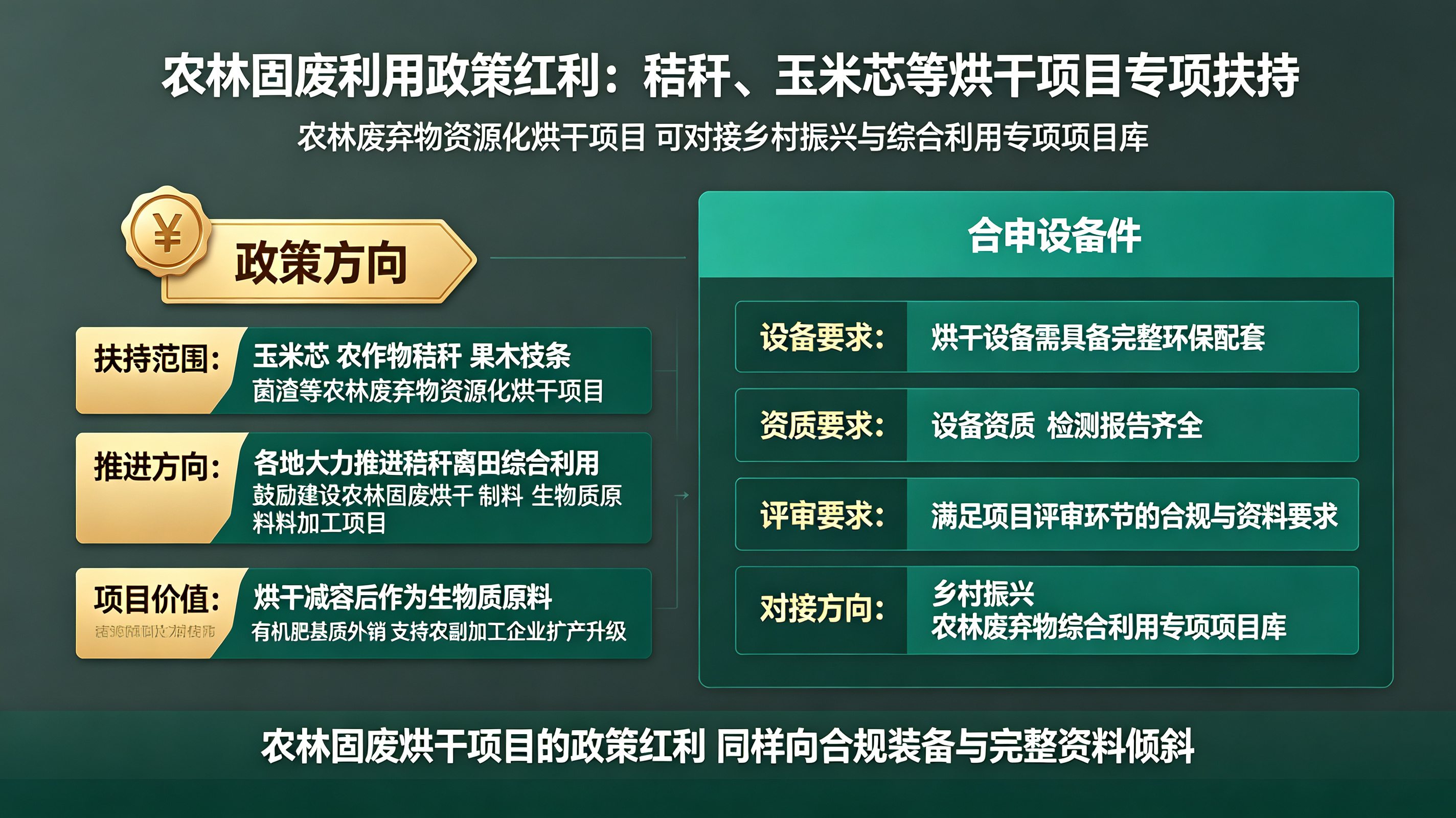
除畜禽粪污外,玉米芯、农作物秸秆、果木枝条、菌渣等农林废弃物资源化烘干项目,同样可申领农林专项扶持资金:各地大力推进秸秆离田综合利用,鼓励建设农林固废烘干、制料、生物质原料加工项目,支持农副加工企业扩产升级。将秸秆、玉米芯通过烘干减容,作为生物质原料、有机肥基质外销,项目可对接乡村振兴、农林废弃物综合利用专项项目库。这类项目同样要求烘干设备具备完整环保配套,设备资质、检测报告齐全,方可进入项目评审环节。
IV. Policy Dividends for Agricultural and Forestry Solid Waste Utilisation: Special Support for Drying Projects of Straw, Corn Cobs and More
Beyond livestock manure, drying projects for resource utilisation of corn cobs, crop straw, fruit tree branches, mushroom residue and other agricultural and forestry waste are also eligible for special agricultural and forestry funding.
Regions are vigorously promoting off-field comprehensive utilisation of straw and encouraging construction of drying, material preparation and biomass feedstock processing facilities for agricultural and forestry waste, supporting capacity expansion and upgrading of agricultural by-product processors. Projects that reduce the volume of straw and corn cobs via drying for sale as biomass feedstock or organic fertiliser substrate can be included in special project libraries for rural revitalisation and comprehensive utilisation of agricultural and forestry waste.
Such projects also require complete environmental supporting facilities for drying equipment, with full equipment qualifications and test reports to pass project review.
五、财税减免利好政策:固废资源化项目多重税费优惠加持
固废综合利用、有机肥原料加工企业,在设备投产运营后,可享受多重税收优惠,进一步放大项目收益:
1.增值税即征即退:以畜禽粪污、玉米芯、秸秆等农林剩余物为原料,生产有机肥原料、生物质产品,符合目录条件可申请增值税即征即退政策;受托开展固废烘干处理劳务,按规定适用对应增值税税率。
2.企业所得税优惠:从事资源综合利用项目,符合条件可享受所得税减计收入、三免三减半等优惠政策。
3.用电优惠:畜禽养殖粪污处理设施,可按规定申请农业生产用电价格,降低烘干设备长期运行电费成本。
V. Fiscal and Tax Incentives: Multiple Preferential Policies for Solid Waste Resource Utilisation Projects
Enterprises engaged in comprehensive solid waste utilisation and organic fertiliser raw material processing may enjoy multiple tax benefits after commissioning, further boosting project returns:
VAT refund upon collection: Enterprises producing organic fertiliser raw materials and biomass products using agricultural and forestry residues such as livestock manure, corn cobs and straw as raw materials may apply for VAT refund upon meeting catalogue requirements. Contract solid waste drying services are subject to corresponding VAT rates per regulations.
Corporate income tax incentives: Qualified comprehensive resource utilisation projects may enjoy preferential policies such as income reduction or “three years tax exemption and three years tax reduction”.
Electricity price incentives: Livestock manure treatment facilities may apply for agricultural production electricity rates in accordance with regulations, cutting long-term power costs of drying equipment.
六、合规设备适配要求:金万泓全系设备匹配2026 国标,支持项目申报
金万泓卧式闪蒸鸡粪烘干机、秸秆单筒烘干设备、玉米芯专用烘干机、工业固废烘干成套装备,全部按照最新国标研发制造:
全套资质、第三方检测报告齐全,能效、粉尘排放、无害化指标均可核验;
设备密闭流化结构,自带除尘除臭配套,满足环评验收、现场核查要求;
设备资料完整,可直接用于项目备案、环评审核、补贴申报材料提交。
选购设备阶段就优先匹配政策标准,避免项目建成后,因设备不达标无法验收、拿不到补贴,造成资金浪费。
VI. Compliance Equipment Matching Requirements: All Jinwanhong Units Meet 2026 National Standards and Support Project Applications
Jinwanhong horizontal flash evaporation chicken manure dryers, three-pass straw dryers, dedicated corn cob dryers and complete industrial solid waste drying lines are all developed and manufactured in line with the latest national standards:
Complete qualifications and third-party test reports available; energy efficiency, dust emission and harmlessness indicators are verifiable.
Enclosed fluidised structure with built-in dust and odour removal accessories to satisfy EIA acceptance and on-site inspection requirements.
Complete equipment documentation, directly usable for project filing, EIA review and subsidy application submissions.
Select equipment aligned with policy standards at the procurement stage, avoiding the risk of failed acceptance and lost subsidies after project completion due to non-compliant equipment.
七、申报避坑指南+ 落地案例,避开补贴申报常见雷区
✅ 申报时间节点与必备材料清单
1.时间节点:每年各地农业农村局会发布项目申报通知,有固定窗口期,逾期不再受理,需要提前准备项目备案、环评、场地证明、设备合同、检测报告;
2.必备材料:项目备案文件、环评批复、土地证明、设备采购合同、设备检测报告、厂区现场照片、投资凭证;
3.主体要求:申报主体无环保处罚、无失信记录,近三年无重大污染事故,否则直接驳回申报。
❌ 高频驳回原因(重点避坑)
1.设备选型不合规:采购简易烘干设备,无检测报告,能效、环保指标不满足新规;
2.材料滞后:项目完工验收后才准备申报材料,错过当年申报窗口期;
3.项目手续缺失:缺少备案、环评等前置审批文件;
4.一票否决项:企业存在环保处罚记录、厂区异味粉尘超标,直接取消申报资格。
VII. Application Pitfall Guide + Implementation Cases: Avoid Common Subsidy Application Mistakes
✅ Application timelines and mandatory document checklist
Timelines: Local agricultural and rural bureaus release project application notices each year with fixed windows. Late submissions are rejected. Prepare project filing, EIA, site certificates, equipment contracts and test reports in advance.
Mandatory documents: Project filing documents, EIA approvals, land certificates, equipment procurement contracts, equipment test reports, on-site factory photos and investment vouchers.
Applicant requirements: Applicants must have no environmental penalties or bad credit records and no major pollution incidents in the past three years; otherwise applications will be rejected directly.
❌ Top reasons for rejection (critical pitfalls)
Non-compliant equipment selection: Purchasing simple drying equipment without test reports; energy efficiency and environmental indicators fail new regulations.
Delayed documentation: Preparing application materials only after project completion and acceptance, missing the annual application window.
Missing pre-approval documents: Lack of filing, EIA and other prior administrative approvals.
Veto clause: Enterprises with environmental penalties or excessive on-site odour/dust will have their eligibility revoked immediately.
真实落地案例
案例1:山东蛋鸡养殖场技改补贴项目 原有老式滚筒烘干设备能耗高、粉尘异味超标,采用金万泓卧式闪蒸设备原位技改,全套资料齐全,项目验收后成功申领畜禽粪污技改专项补贴,降低设备投入,同时顺利通过环保常态化核查。
案例2:苏农林产业园秸秆 + 玉米芯烘干项目 产业园配套金万泓三回程烘干产线,用于农林固废烘干预处理,项目入库农林废弃物综合利用专项,享受设备补贴+ 资源综合利用税收优惠,烘干成品外销稳定创收。
Real Implementation Cases
Case 1: Technical renovation subsidy project for an egg farm in Shandong The farm’s old rotary drum dryer had high energy consumption and excessive dust and odour. On-site renovation with Jinwanhong horizontal flash evaporation equipment was completed with full documentation. After project acceptance, the farm successfully obtained a special livestock manure renovation subsidy, cutting equipment investment and smoothly passing routine environmental inspections.
Case 2: Straw and corn cob drying project at an agricultural and forestry industrial park in Jiangsu The park deployed a Jinwanhong three-pass drying line for pre-treatment of agricultural and forestry solid waste. The project was included in the special agricultural and forestry waste comprehensive utilisation programme, enjoying equipment subsidies plus tax incentives for comprehensive resource utilisation. Dried finished products generate stable revenue through external sales.
结语
2026 年农牧固废烘干项目,合规是底线,政策是红利。很多企业只关注设备采购成本,忽略设备是否符合最新能效、环保标准,等到项目验收、申报补贴时才发现设备不达标,造成巨大损失。
读懂政策、选对合规烘干设备,既能顺利通过环保督查守住生产底线,又可以积极对接地方专项补贴、税收优惠,降低项目投入,放大资源化收益。
如果你正在规划粪污、农林固废烘干项目,想要评估设备合规性、梳理本地补贴申报材料,欢迎联系金万泓机械,获取政策与设备选型一对一咨询。
For agricultural and pastoral solid waste drying projects in 2026, compliance is the bottom line and policy support is a valuable dividend. Many enterprises only focus on equipment procurement costs and ignore whether equipment meets the latest energy efficiency and environmental standards. They discover non-compliance only during project acceptance and subsidy applications, incurring heavy losses.
Understanding policies and selecting compliant drying equipment enables enterprises to smoothly pass environmental inspections and secure production. It also allows active access to local special subsidies and tax incentives to lower project investment and increase resource-based revenue.
If you are planning manure or agricultural solid waste drying projects and wish to assess equipment compliance and organise local subsidy application documents, contact Jinwanhong Machinery for one-on-one consultation on policy and equipment selection.