【引言】
在规模化畜禽粪污资源化项目落地运营的过程中,绝大多数养鸡场都会遇到同一个核心难题:鸡粪烘干环节的燃料消耗,占据整套产线运营成本最大比重。很多养殖场前期采购烘干主机时,只对比设备采购报价,忽略热源系统的长期运营开支,等到项目正式投产之后才发现,高额燃料费用不断吞噬有机肥外销、种养循环带来的收益,严重情况下,直接造成整个粪污处理项目持续亏损。
During the implementation and operation of large-scale livestock and poultry manure resource utilisation projects, the vast majority of chicken farms encounter the same core challenge: fuel consumption for chicken manure drying accounts for the largest share of the overall production line’s operating costs. When purchasing drying main units in the early stage, many farms only compare equipment quotations while ignoring the long-term operating expenses of the heat source system. Once the project goes into formal operation, they find that high fuel costs keep eroding revenue from organic fertiliser sales and crop-livestock recycling. In severe cases, the entire manure treatment project runs at a persistent loss.
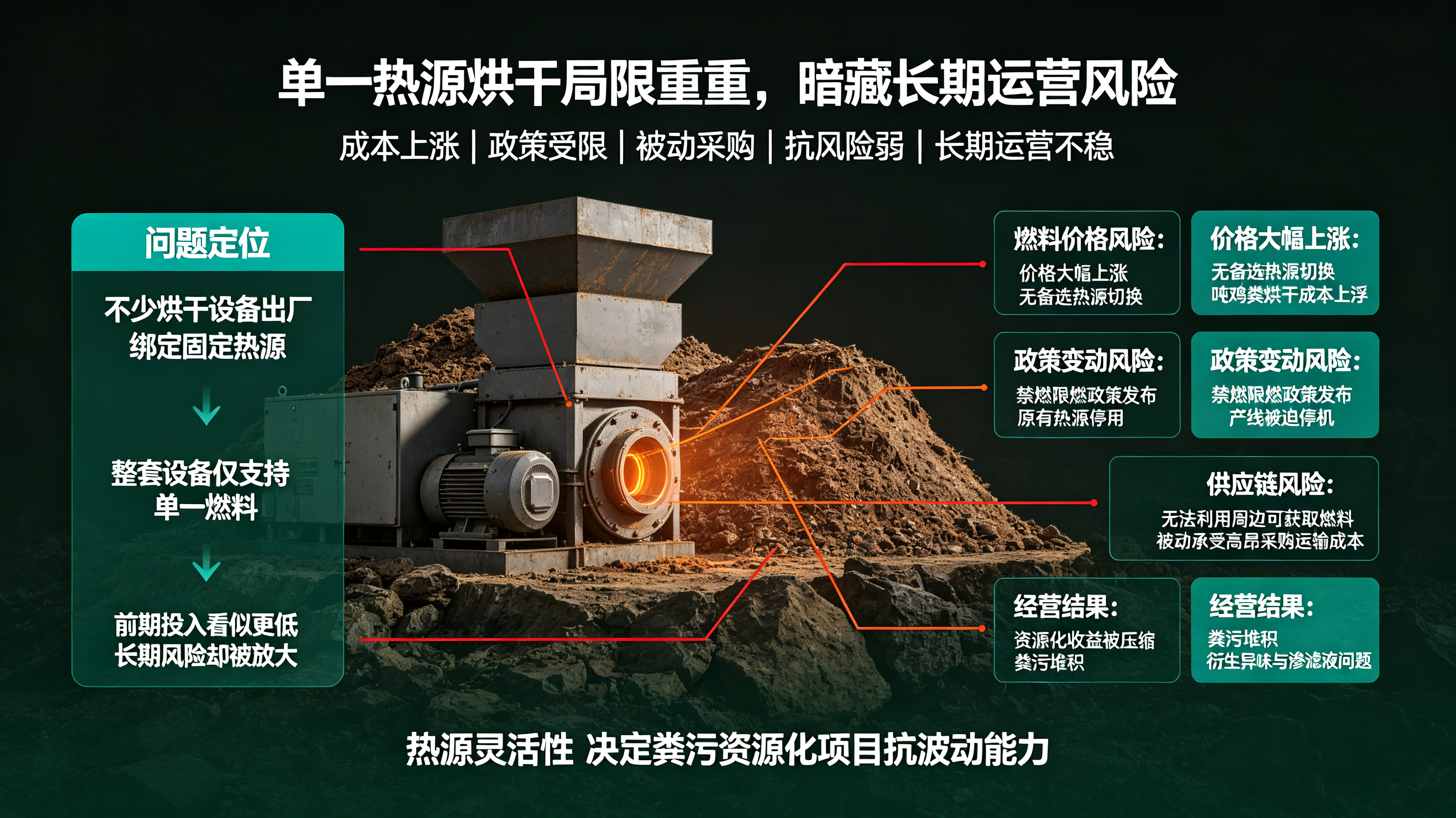
一、 单一热源烘干局限重重,暗藏长期运营风险
市场上不少烘干设备在出厂阶段就绑定固定热源,整套设备仅支持单一燃料使用。这类方案看似前期一次性投入更低,但是长期生产过程中潜藏多重风险。
当市场燃料价格出现大幅上涨时,项目没有备选热源切换空间,吨鸡粪烘干能耗成本同步上浮,资源化收益被持续压缩;一旦当地发布燃料管控、禁燃限燃相关政策,原有热源无法继续投入使用,整套烘干产线只能被迫停机,养殖场粪污堆积无法及时处置,又会衍生堆存异味、渗滤液等一系列环保问题。
同时,单一热源设备没有灵活调整空间,无法根据项目周边可获取燃料资源动态调整方案,养殖场只能被动承受高昂燃料采购与运输成本。这种方案把整个粪污资源化项目的经营风险,全部绑定在单一燃料品类上,项目抗市场波动、政策变动的能力极弱。
I. Limitations of Single-heat-source Drying and Hidden Long-term Operational Risks
Many dryers on the market come pre-configured with a fixed heat source and only support one type of fuel. Such solutions appear to require lower upfront one-time investment, yet carry multiple hidden risks during long-term production. When fuel prices surge, the project has no alternative heat source to switch to. The energy cost per tonne of dried chicken manure rises accordingly, squeezing resource utilisation profits. Should local authorities introduce fuel control or combustion restriction policies, the original heat source can no longer be used, forcing the entire drying line to shut down. Accumulated manure at the farm cannot be disposed of promptly, triggering a string of environmental issues including odour build-up and leachate.
Furthermore, single-heat-source equipment lacks flexibility and cannot adjust dynamically based on available fuel resources around the site. Farms are forced to bear high fuel procurement and transportation costs. This model ties all operational risks of the manure resource project to one single fuel type, leaving the project highly vulnerable to market price swings and policy changes.
二、 卧式闪蒸主机热源适配特性:模块化热风系统,多热源无缝对接
金万泓卧式闪蒸烘干机搭载模块化热风供给系统,主机流化烘干工艺独立稳定,标准化热风接口设计,能够灵活对接生物质、天然气、燃煤、空气能等多种热源设备。
各类热源产出的热风,经过稳压、换热、温控调节之后送入主机干燥腔体,热风温度、风压参数均可精准调节。更换不同热源配套时,不会破坏内部打散流化脱水工艺,鸡粪物料的干燥过程不受影响,成品有机肥原料含水率稳定可控,品质保持统一。
整套热风单元独立模块化设计,后期如果项目所在地燃料供应条件、环保管控政策发生变化,烘干主机无需更换,仅对前端热源单元进行改造替换即可,不需要整套产线报废重建,极大延长产线使用周期,降低后期技改投入。
II. Heat Source Adaptation of Horizontal Flash Evaporation Main Unit: Modular Hot-air System with Seamless Connection to Multiple Heat Sources
Jinwanhong horizontal flash evaporation dryers adopt a modular hot-air supply system. The fluidised drying process of the main unit remains independent and stable. Standardised hot-air interfaces enable flexible integration with various heat source equipment including biomass, natural gas, coal and air-source heat pumps.
Hot air generated by different heat sources is stabilised, heat-exchanged and temperature-regulated before entering the drying chamber of the main unit. Hot-air temperature and air pressure can be precisely adjusted. Switching to alternative heat sources will not disrupt the internal crushing, fluidisation and dehydration process. The drying of chicken manure remains unaffected, and the moisture content of finished organic fertiliser raw material stays stable with consistent quality.
The whole hot-air unit adopts an independent modular design. If local fuel supply conditions or environmental control policies change later, there is no need to replace the drying main unit. Only the front-end heat source module needs modification or replacement, avoiding scrapping and rebuilding the whole production line. This greatly extends equipment service life and cuts later technical renovation costs.
三、各类热源深度对比分析,厘清不同热源适用场景
✅ 生物质燃烧机 以秸秆、木屑、果壳、农林边角料作为燃料,燃料取材方便,采购单价低,适合周边农林废弃物资源丰富的大型养殖基地。在消耗农林废料的同时实现热能供给,形成区域循环经济模式,长期运行成本优势显著。需要配套对应的烟气除尘净化系统,满足当地尾气排放要求。
✅ 天然气热源 燃烧洁净,烟尘、污染物排放少,配套环保设施简单。适合靠近天然气管网、位于近郊或者环保管控严格的养殖园区。设备启停响应速度快,操作简便,人工运维工作量小;短板在于单位热能成本偏高,燃料价格受管网供气行情影响。
✅ 燃煤热源 单位热能综合运行成本低廉,适合远离城区、煤炭供应稳定、属地政策允许燃煤使用的大型规模化养殖产业园。该热源必须配套完整的脱硫、除尘、脱硝尾气处理系统,严格遵守区域大气排放限值,环保配套投入相对更高。
热源选型不能只盯着燃料单价,必须综合考量本地燃料采购价格、运输距离、存储成本、属地环保政策、项目日产湿粪规模,综合测算项目全生命周期运营成本,才能选出最合适的热源方案。
III. In-depth Comparison of Various Heat Sources and Applicable Scenarios
✅ Biomass burner: Uses crop straw, wood chips, nut shells and agricultural & forestry residues as fuel. Fuel is easy to source at low purchase prices, suitable for large breeding bases with abundant agricultural and forestry waste nearby. It supplies thermal energy while consuming waste, forming a regional circular economy and delivering prominent long-term cost advantages. A supporting flue gas dust removal and purification system is required to meet local tail gas emission standards.
✅ Natural gas heat source: Clean combustion with minimal smoke and pollutant emissions, requiring simple supporting environmental facilities. Ideal for breeding parks close to natural gas pipelines, suburban areas or regions under strict environmental supervision. Fast startup and shutdown response, simple operation and low manual maintenance workload. Its drawback lies in higher thermal energy unit cost, subject to fluctuations in pipeline gas supply.
✅ Coal-fired heat source: Low comprehensive operating cost per unit of heat. Suitable for large-scale breeding industrial parks far from urban areas with stable coal supply and where coal burning is permitted by local policies. This heat source must be equipped with a complete flue gas desulphurisation, dust removal and denitrification system to strictly comply with regional atmospheric emission limits, resulting in relatively higher environmental supporting investment.
Heat source selection should not focus merely on fuel unit price. It requires comprehensive evaluation of local fuel purchase price, transportation distance, storage cost, regional environmental policies and daily wet manure processing capacity. Full-life-cycle operating cost calculation is essential to identify the most suitable heat source solution.
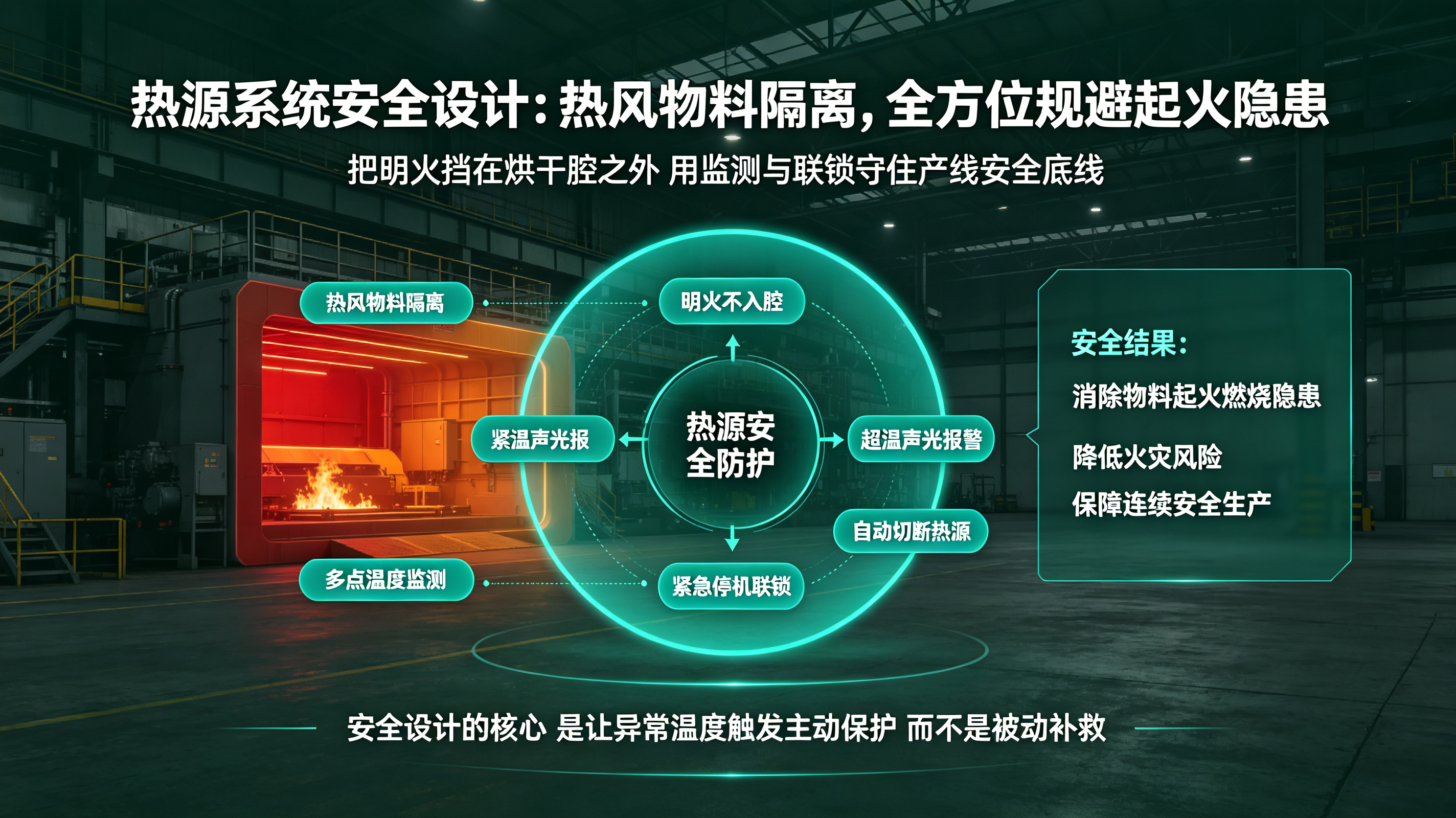
四、 热源系统安全设计:热风物料隔离,全方位规避起火隐患
鸡粪有机质含量高,烘干状态下有机质粉尘存在自燃风险,热源系统的安全防护是整套产线不可忽视的底线。金万泓整套热源换热系统采用热风与物料隔离换热结构,明火不会直接通入烘干主机腔体,从源头杜绝明火与有机质鸡粪物料直接接触,有效消除物料起火燃烧隐患。系统配套多点温度监测、超温声光报警、紧急停机联锁保护装置。当监测点位温度出现异常升高,系统会自动联动切断热源供给,同步触发应急保护机制,保障整套产线连续、安全生产,降低火灾风险。
IV. Safety Design of Heat Source System: Isolation of Hot Air and Materials to Fully Mitigate Fire Hazards
Chicken manure contains high organic matter, and dried organic dust carries spontaneous combustion risks. Safety protection of the heat source system is an indispensable bottom line for the whole production line. Jinwanhong’s complete heat exchange system adopts a structural design separating hot air from materials. Open flame is not directly fed into the drying chamber of the main unit. This fundamentally prevents direct contact between open flame and organic chicken manure, effectively eliminating fire risks.
The system is fitted with multi-point temperature monitoring, sound-light over-temperature alarms and interlock emergency shutdown protection. If abnormal temperature rise is detected, the system automatically cuts off heat supply and triggers emergency protection mechanisms to ensure continuous and safe production of the whole line and reduce fire risks.
五、 定制热源组合方案,精细化测算长期能耗成本
我们不做一刀切的标准化热源打包方案,坚持先现场勘察,再定制方案的服务模式。技术团队实地调研养殖场项目所在地燃料资源储备、环保管控条例、场地布局,结合鸡场养殖规模、每日湿鸡粪处理量,开展精细化能耗测算,输出适配项目的热源方案。针对部分特殊工况,还可设计复合热源搭配方案,主热源搭配备用辅助热源。在主燃料供应紧张、价格暴涨阶段切换备用热源,平抑烘干运营成本波动,保障粪污处置不间断。
V. Custom Heat Source Combination Solutions with Refined Long-term Energy Cost Calculation
We reject one-size-fits-all bundled heat source packages and adhere to the service model of on-site survey first followed by customised solution design. Our technical team conducts field investigations into local fuel reserves, environmental regulations and site layout. Combined with farm scale and daily wet chicken manure throughput, we perform refined energy consumption calculation and deliver tailored heat source schemes.
For certain special working conditions, composite heat source configurations can be designed: a primary heat source paired with an auxiliary backup heat source. When the main fuel supply is tight or prices spike, the backup heat source can be switched on to smooth fluctuations in drying operating costs and ensure uninterrupted manure disposal.
六、 落地案例:不同地区鸡场,生物质、天然气热源实际运营对比
案例一:鲁西地区大型规模化鸡场,场区周边农田秸秆、木屑资源充足,项目选用生物质热源配套卧式闪蒸烘干产线。就地收购农林废弃物作为燃料,燃料采购与运输成本可控。整套产线全年连续稳定运行,烘干产出的有机肥原料对外销售,收益可以覆盖燃料消耗、设备运维等开支,成功把粪污环保负担转变为稳定增收项目。
案例二:城郊养殖产业园,区域大气环保管控标准严苛,场区接入市政天然气管网,配套天然气热风热源。整套产线尾气洁净,配套除臭除尘系统简单,项目环保验收一次性顺利通过。虽然单位燃料运行成本高于生物质方案,但日常运维简单,人工投入少,产出有机肥原料品质稳定,适合商品有机肥外销高标准项目。
两个项目采用同款卧式闪蒸烘干主机,仅前端热源单元配置不同,依托因地制宜的热源选型,均实现稳定投产、达标排放,资源化项目持续创造收益。
VI. Real Cases: Operational Comparison of Biomass and Natural Gas Heat Sources at Chicken Farms in Different Regions
Case 1: A large-scale chicken farm in western Shandong has abundant straw and wood chips from surrounding farmland. The project deploys a horizontal flash evaporation drying line supported by a biomass heat source. Agricultural and forestry waste purchased locally keeps fuel procurement and transportation costs under control. The whole line runs stably year-round. Revenue from selling dried organic fertiliser raw material covers fuel consumption and equipment maintenance, successfully turning the environmental burden of manure into a steady income-generating project.
Case 2: A suburban breeding industrial park under strict regional atmospheric emission standards is connected to the municipal natural gas pipeline and adopts a natural gas hot-air heat source. Tail gas from the whole line is clean with simple supporting deodorisation and dust removal systems. The project passed environmental acceptance in one attempt. Although its unit fuel operating cost is higher than the biomass option, daily maintenance is simple with low labour input, and the finished organic fertiliser raw material maintains stable quality, making it suitable for high-standard projects selling commercial organic fertiliser.
Both projects use identical horizontal flash evaporation main units, differing only in front-end heat source modules. By selecting heat sources adapted to local conditions, both achieve stable commissioning, compliant emissions and sustained revenue from resource utilisation.
写在最后
鸡粪烘干资源化项目能不能盈利,卧式闪蒸主机的脱水工艺是基础保障,而热源选型直接锁定长期运营成本底线。采用固定单一热源的烘干产线,极易受到燃料市场行情、地方环保政策变动冲击,生产稳定性差。卧式闪蒸模块化多热源适配方案,给养殖场充足的调整弹性,立足项目本地资源条件选对热源,持续压缩烘干能耗开支,保障粪污资源化项目长效稳定盈利。
如果您正在规划鸡粪烘干产线,想要测算不同热源方案的能耗、运行成本对比,可咨询获取专属项目热源评估方案。
The profitability of a chicken manure drying resource project relies on the dehydration technology of the horizontal flash evaporation main unit as the foundational guarantee, while heat source selection directly sets the baseline for long-term operating costs. Drying lines with fixed single heat sources are vulnerable to fuel market volatility and changes in local environmental policies, leading to poor production stability. The modular multi-heat-source compatible scheme of horizontal flash evaporation provides farms with ample adjustment flexibility. Selecting the right heat source based on local resource conditions continuously cuts drying energy consumption and ensures long-term stable profitability of manure resource projects.
If you are planning a chicken manure drying line and wish to compare energy consumption and operating costs of different heat source options, contact us for a dedicated project heat source assessment solution.