【引言】
不少打算入局生物质颗粒项目的创业者,前期最容易踩坑:只盯着颗粒机价格,忽略整套产线配套,原料没处理好、水分不达标、产能达不到预期,投入几十万设备最后产能拉胯,投产即亏损。
生物质颗粒不是单台机器就能做,是一套连贯的成套系统。原料破碎、烘干、制粒、冷却每一环都环环相扣。今天这篇选型科普,从市场前景、工艺流程、设备配置、产能规划、建厂条件到落地案例一次性讲透,新手建厂收藏好,避免盲目投资。
Many entrepreneurs planning to enter the biomass pellet industry easily fall into traps at the early stage: they only focus on the price of the pellet mill while ignoring supporting equipment for the whole production line. Poor raw material treatment, off-spec moisture content and failure to hit target output lead to underperformance after investing hundreds of thousands in machinery, resulting in losses immediately after commissioning.
Biomass pellets cannot be produced by a single machine; they require a complete, interconnected system. Raw material crushing, drying, pelleting and cooling are closely linked processes. This equipment-selection guide covers market outlook, technological workflow, equipment configuration, capacity planning, factory construction requirements and real project cases in full detail. New factory builders may save this guide to avoid blind investment.
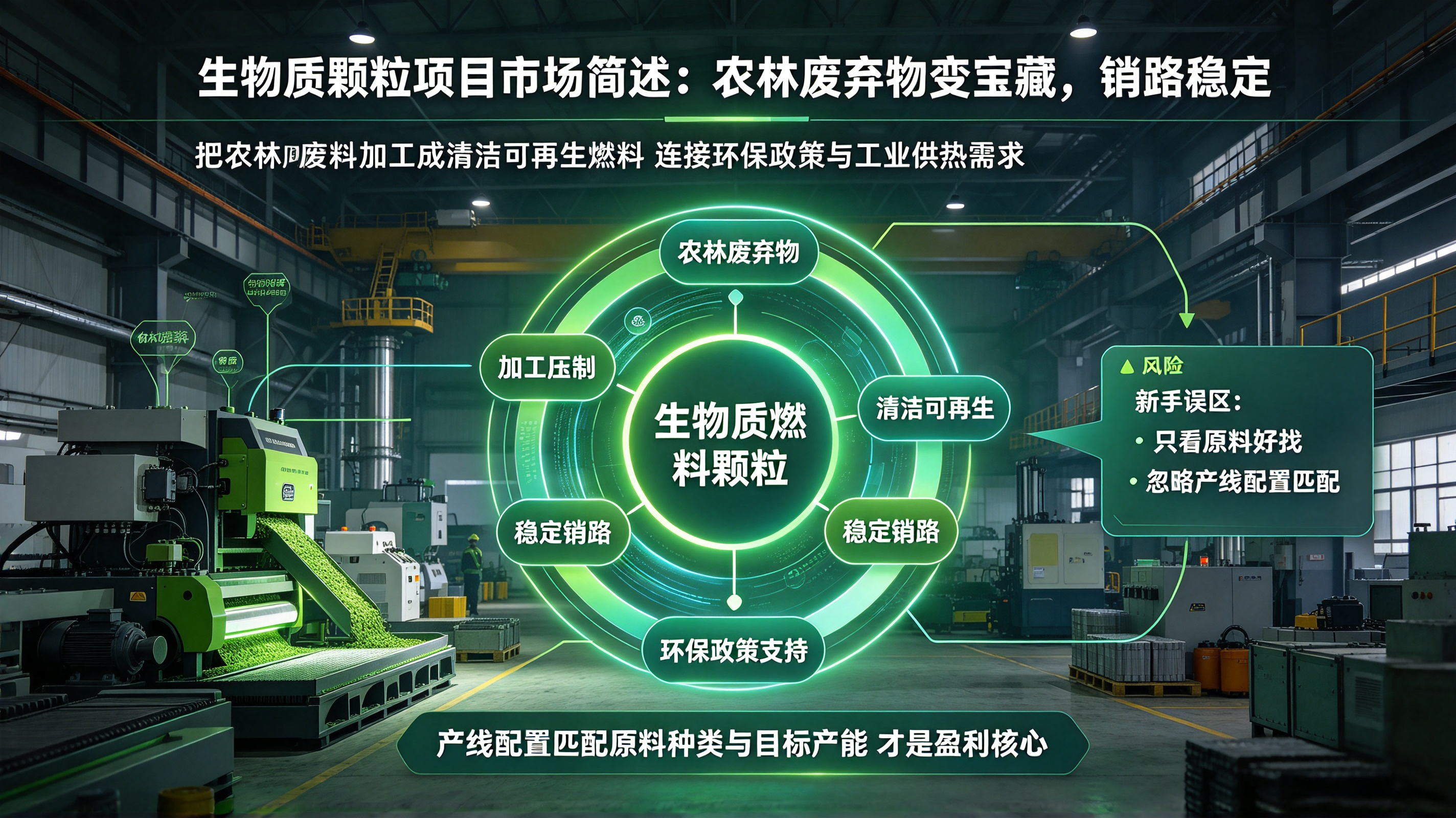
一、生物质颗粒项目市场简述:农林废弃物变宝藏,销路稳定
双碳背景下,农林废弃物资源化利用成为热门赛道。木屑、树枝、秸秆、果木枝丫等农林废料,经过加工压制成生物质燃料颗粒,属于清洁可再生燃料。
成品生物质颗粒主要供应:锅炉供热企业、生物质电厂、烘干厂、洗浴中心、供暖单位等。相比原煤,燃烧污染更低,符合环保政策要求,原料来源广,农林产区原料采购成本可控。
但项目能不能盈利,核心不在于原料好不好找,产线配置是否匹配你的原料种类、目标产能,才是关键。很多新手就是前期设备选型错位,造成后续生产成本高、故障多。
I. Market Overview of Biomass Pellet Projects: Turning Agricultural and Forestry Residues into Valuable Commodities with Stable Sales
Against the backdrop of the dual-carbon goals, resource utilisation of agricultural and forestry waste has become a popular sector. Wood chips, branches, straw, fruit tree twigs and other agro-forestry residues can be processed and compressed into biomass fuel pellets, a clean renewable fuel.
Finished biomass pellets are mainly supplied to boiler heating enterprises, biomass power plants, drying factories, bath centres and heating suppliers. Compared with raw coal, they produce lower combustion pollution and comply with environmental policies. Raw materials are widely available, and procurement costs are controllable in agricultural and forestry regions.
Nevertheless, project profitability does not hinge mainly on raw material availability. The key lies in whether the production line matches your raw material type and target output. Many new investors select mismatched equipment at the initial stage, leading to high production costs and frequent breakdowns later.
二、完整工艺流程拆解:从废料到颗粒,7 大工序一步不能少
一条标准生物质颗粒成套生产线,完整流程:原料预处理(破碎)→粉碎→烘干→制粒→冷却→成品筛分→包装
1.破碎工段:大块树枝、原木、秸秆,先粉碎到制粒所需粒度。原料尺寸过大,制粒机负载飙升,极易堵机。
2.粉碎工段:粉碎工段主要对原料进行破碎、粉碎处理,将大块物料加工成符合粒度要求的粉料 / 颗粒。
3.烘干工段:制粒黄金水分区间一般控制在 10-20%。原料水分过高,颗粒松散不成型;水分过低,容易过热、粉尘大。烘干是整条产线的核心控制点。
4.制粒工段:核心主机,将合格粉料挤压成型,形成圆柱状生物质颗粒。
5.冷却工段:刚产出的高温颗粒温度高、质地脆,冷却降温后提升颗粒硬度,减少破碎率。
6.成品筛分:筛掉碎粉、不合格碎屑,保证成品颗粒外观与品质,提升客户认可度。
7.包装工段:自动定量打包,方便仓储、运输、销售。
整条产线配套输送与除尘系统,物料密闭输送,收集生产粉尘,满足环保生产要求。
II. Breakdown of the Complete Process: Seven Indispensable Steps from Waste to Pellets
A standard full biomass pellet production line follows this workflow: Raw material pre-treatment (primary crushing) → fine grinding → drying → pelleting → cooling → finished product screening → packaging
Primary crushing: Large branches, logs and straw are crushed down to the particle size required for pelleting. Over-sized raw materials overload the pellet mill and easily cause blockages.
Fine grinding: Further crush and grind materials to produce powder or small particles meeting the required fineness for pelleting.
Drying: The optimal moisture range for pelleting is generally 10–20%. Excessively wet raw materials form loose pellets that fail to hold shape; overly dry materials overheat and generate heavy dust. Drying is the core control point for the whole line.
Pelleting: The core host machine compresses qualified powder into cylindrical biomass pellets.
Cooling: Fresh hot pellets are brittle. Cooling lowers their temperature, increases hardness and reduces breakage.
Finished product screening: Remove fine powder and defective fragments to guarantee pellet appearance and quality and boost customer recognition.
Packaging: Automatic quantitative bagging for convenient warehousing, transport and sales.
The full line is equipped with conveying and dust collection systems. Materials are conveyed in closed pipelines to capture production dust, meeting environmental production requirements.
三、各工段设备作用详解,看懂设备再采购
✅ 破碎机 作为整条产线第一道预处理设备,负责把原木、枝丫、秸秆等大块物料破碎至制粒所需粒度。树枝硬度高,可选重型破碎机型;秸秆纤维长,优先选用防缠绕结构。
✅ 粉碎机 分木屑破碎机、秸秆粉碎机。针对原木、枝丫、秸秆做粉碎。树枝硬度高,要选强力破碎机型;秸秆质地轻、纤维长,破碎结构要适配长纤维物料,避免缠机。
✅ 滚筒烘干机 生物质原料水分波动大,高湿原料必须烘干。滚筒烘干机处理量大,运行稳定,适配木屑、秸秆等轻质农林物料。热源可根据厂区条件选择生物质燃烧机、天然气、燃煤等方案。
✅ 颗粒机 整条产线核心。分为环模颗粒机为主流机型,稳定性强,适合连续工业化生产。环模孔径根据客户需求成品颗粒规格选配。
✅ 冷却机 逆流式冷却机为主,热颗粒和冷风逆向接触,冷却均匀,降低颗粒温度,提升成品强度,减少粉料。
✅ 包装机 定量自动包装,可设置每袋 50kg 等常规规格,自动称重缝包,节省人工。
✅ 除尘、输送系统 皮带输送机、螺旋输送机、闭风器、脉冲除尘器。负责物料转运,收集各工序粉尘,降低现场粉尘,满足环评粉尘治理要求,保障车间生产环境。
III. Functions of Equipment in Each Section: Understand Machinery before Purchase
✅ Crusher The first pre-treatment device of the whole line. It breaks logs, twigs and straw into the particle size required for pelleting. Heavy-duty models are recommended for hard branches; anti-tangling structures are preferred for long-fibre straw.
✅ Grinder Includes wood grinders and straw grinders for processing logs, twigs and straw. Heavy-duty crushing units are needed for hard branches. For lightweight, long-fibre straw, the crushing structure must adapt to long fibres to prevent winding jams.
✅ Rotary drum dryer Biomass raw materials have volatile moisture levels, and high-moisture feedstock must be dried. Rotary drum dryers feature large throughput and stable operation, suitable for lightweight agro-forestry materials such as wood chips and straw. Heat sources including biomass burners, natural gas and coal can be selected according to plant conditions.
✅ Pellet mill The core of the entire line. Ring die pellet mills are the mainstream type with strong stability for continuous industrial production. Ring die aperture is selected according to customer requirements for finished pellet specifications.
✅ Cooler Counter-flow coolers are commonly used. Hot pellets contact cold air in reverse flow for uniform cooling, lowering pellet temperature, improving finished strength and reducing powder generation.
✅ Packaging machine Automatic quantitative packaging, supporting common specifications such as 50 kg per bag, with automatic weighing and sewing to cut labour costs.
✅ Dust removal & conveying systems Belt conveyors, screw conveyors, air locks and pulse dust collectors handle material transfer and collect dust generated in each process, lowering on-site dust levels, meeting EIA dust control standards and safeguarding workshop working conditions.
 四、原料差异对产线配置的影响:木屑、秸秆、枝丫材方案不一样
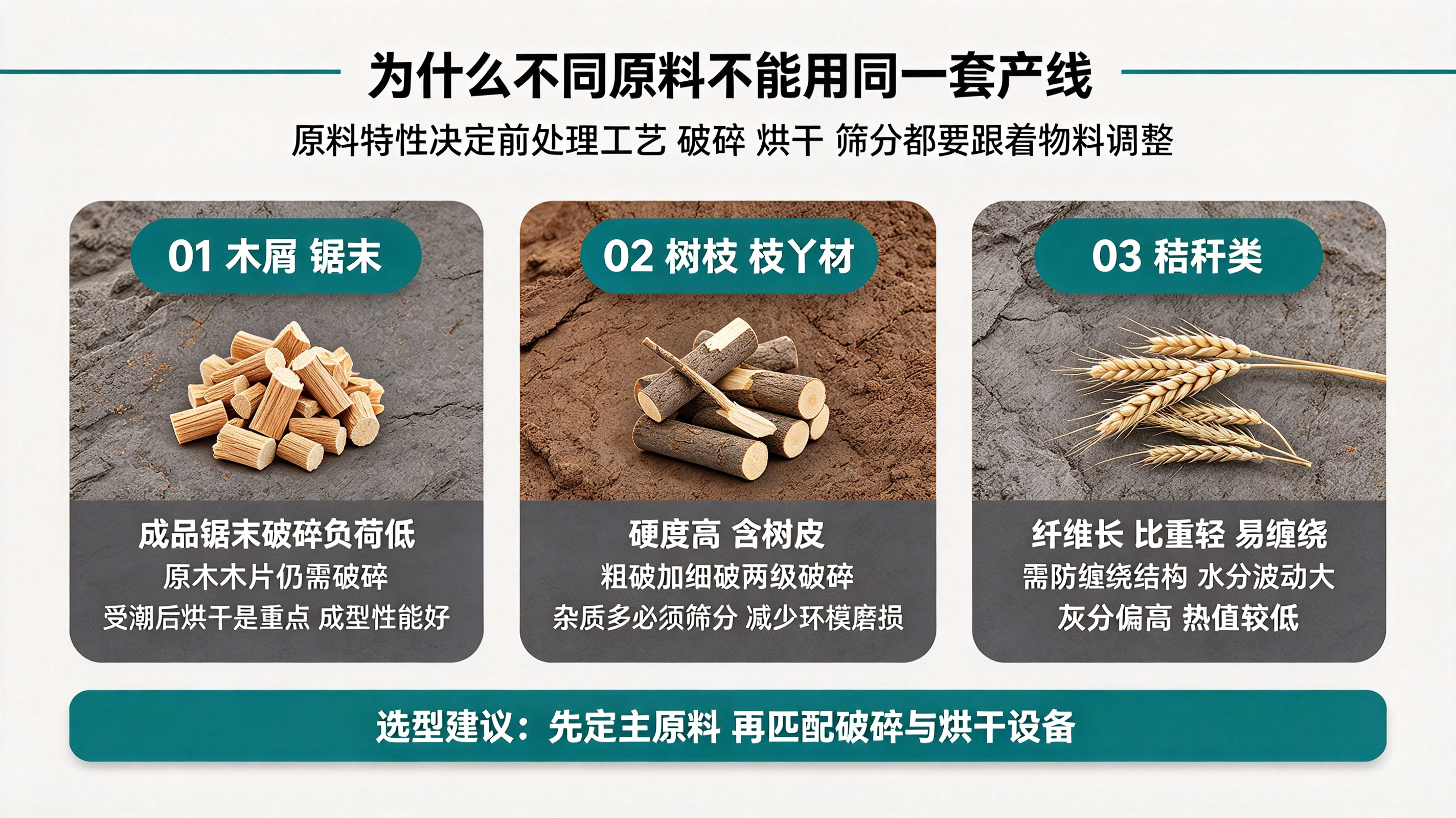
很多客户容易犯一个错误:一套设备想通吃所有原料。不同物料特性差异巨大,前道处理方案必须调整:
1.木屑(锯末):原料本身粒度较好。如果是成品锯末,破碎工段负荷低;但原木木片,依旧需要破碎。木屑堆积易受潮,烘干是重点。成型性能好,是做颗粒最理想原料。
2.树枝 / 枝丫材:硬度高,含树皮。破碎工序要求高,需要粗破 + 细破两级破碎。杂质偏多,筛分不能省,否则严重磨损颗粒机环模。
3.秸秆(玉米秸秆、小麦秸秆):纤维长、比重轻,极易缠绕设备。破碎要选用防缠绕结构;秸秆原料水分波动极大,并且灰分偏高,成品颗粒热值低于木屑,在规划产能和销售定价时要提前考量。
选型建议:先确定你本地主原料是什么,再匹配破碎、烘干设备,不要先定颗粒机再考虑原料。
IV. Impact of Raw Material Differences on Line Configuration: Different Solutions for Wood Chips, Straw and Branch Wood
A common mistake for buyers is expecting one set of equipment to handle all raw materials. Material properties vary greatly, and front-end processing must be adjusted accordingly:
Sawdust: Good inherent particle size. If ready-made sawdust is used, the crushing section bears low load; wood chips still require crushing. Sawdust piles easily absorb moisture, so drying is critical. It has excellent forming performance and is the ideal raw material for pellet production.
Branches / logging residues: High hardness with bark. Two-stage coarse and fine crushing is required. Impurity levels are relatively high, so screening cannot be omitted; otherwise, impurities will severely abrade the pellet mill ring die.
Straw (corn straw, wheat straw): Long fibres and low bulk density, highly prone to tangling machinery. Crushers with anti-winding structures are required. Straw moisture fluctuates drastically and ash content is relatively high. Finished pellets have lower calorific value than wood pellets. This must be considered in capacity planning and sales pricing.
Selection suggestion: Confirm your primary local raw material first, then match crushing and drying equipment. Do not buy the pellet mill before deciding on raw materials.
五、产能规划思路:小型1-2 吨 /h、中型 3-5 吨 /h、大型 6-10 吨 /h 产线配置参考
小型产线:1~2 吨 / 小时 适合初创、原料量不大,场地有限。设备配置精简,投资门槛低。适合个人、小型加工厂,以本地消化颗粒为主。适合原料单一,以木屑为主。人工投入相对多一些。
中型产线:3~5 吨 / 小时 市场主流配置,性价比最高。破碎 + 滚筒烘干 + 环模颗粒机 + 冷却 + 筛分 + 自动包装,整套自动化程度更高,连续生产能力强。适合稳定原料供应,面向周边长期供货的加工厂。
大型产线:6~10 吨 / 小时 规模化工厂,全套自动化流水线,配套完善除尘与集中控制系统,厂房、供电要求高。适合农林原料资源丰富地区,批量外销,需要稳定团队运维,前期总投资较高。
重要提醒:标注产能是原料达标后的稳定产能,原料水分超标、杂质多,实际产量会明显下降,选型时预留余量。
V. Capacity Planning Reference: Small 1–2 t/h, Medium 3–5 t/h, Large 6–10 t/h Line Configurations
Small-scale line (1–2 tons/hour): Suitable for start-ups with limited raw material supply and restricted site space. Streamlined equipment configuration with low investment threshold, for individuals and small processing plants selling pellets locally. Mainly for single feedstock dominated by sawdust; relatively higher labour requirement.
Medium-scale line (3–5 tons/hour): The mainstream market configuration with the best cost-performance. Equipped with crushing + rotary drying + ring die pellet mill + cooling + screening + automatic packaging. Higher automation and strong continuous production capability. Ideal for processing plants with stable raw material supply and long-term supply contracts for surrounding customers.
Large-scale line (6–10 tons/hour): Large-scale factories with fully automated assembly lines, complete dust removal and central control systems, demanding larger workshops and power supply. Suited for regions rich in agro-forestry raw materials for bulk outbound sales. Requires a stable operation and maintenance team and higher upfront total investment.
Important reminder: Rated capacity refers to stable output when raw materials meet standards. Excess moisture or impurities will significantly reduce actual yield. Reserve extra capacity during equipment selection.
六、建厂基础条件:厂房面积、供电、场地、环评粉尘治理要求
1.厂房面积 需要预留原料堆放区、成品仓储区、设备安装检修空间。原料堆场建议防雨,防止物料再次受潮。
2.供电条件 生物质制粒整套设备属于大功率设备,需要提前核算总装机容量。中型、大型产线一般需要接入高压电,建厂前期务必对接电力部门评估变压器容量。
3.场地要求 场地交通便利,方便原料进厂和成品颗粒外运。场地地势平整,做好排水。
4.环保与粉尘治理 生产过程破碎、筛分、制粒工序会产生粉尘。整套产线必须配套脉冲除尘设备,做好粉尘收集。建厂前,提前咨询当地环评要求,粉尘、噪声是核查重点,除尘系统不能简化,避免后期停产整改。
VI. Basic Factory Construction Requirements: Workshop Area, Power Supply, Site, EIA and Dust Control
Workshop area: Reserve zones for raw material stacking, finished goods storage, equipment installation and maintenance. Raw material yards should be rainproof to prevent rewetting of materials.
Power supply: Full biomass pelleting equipment is high-power. Calculate total installed capacity in advance. Medium and large lines generally require high-voltage power supply. Consult power authorities at the early factory planning stage to assess transformer capacity.
Site requirements: Convenient transportation for raw material delivery and finished pellet outbound transport. Flat terrain with proper drainage.
Environmental protection and dust control: Crushing, screening and pelleting generate dust. The whole line must be fitted with pulse dust collectors for dust capture. Check local EIA requirements before construction. Dust and noise are key inspection items. Dust removal systems cannot be simplified to avoid shutdown and rectification later.
七、客户案例:新建木屑颗粒厂成套产线落地参考
山东客户新建木屑颗粒项目,本地原料以原木枝丫、家具厂边角木屑为主,目标产能 3 吨 / 小时。 前期沟通发现客户原本计划只采购一台颗粒机,打算省略烘干工段。现场评估原料常年水分 25% 以上,不烘干无法成型。
最终方案配置:粗破 + 细破 + 筛分 + 滚筒烘干机 + 环模颗粒机 + 冷却机 + 成品筛分 + 自动包装机,配套完整除尘输送系统。 项目落地后,原料水分稳定控制在 15% 左右,生产线连续稳定运行,成品颗粒成型率高,碎粉少,成品供应周边多家供热锅炉企业,投产之后实现稳定出货。
项目总结:生物质颗粒项目,七分看原料预处理,三分看制粒主机,烘干和破碎系统千万不能压缩预算。
VII. Customer Case: Reference for a New Wood Pellet Plant Full Line Implementation
A Shandong customer built a new wood pellet plant, using local log branches and furniture factory wood scraps as raw materials, targeting 3 tons per hour output. During early communication, the customer originally planned to buy only a pellet mill and skip the drying section. Site assessment showed raw material moisture stayed above 25% year-round, making pelleting impossible without drying.
Final configuration: Coarse crushing + fine crushing + screening + rotary drum dryer + ring die pellet mill + cooler + finished screening + automatic packaging machine, plus complete dust removal and conveying systems.
After project commissioning, raw material moisture is stably controlled at around 15%. The production line runs continuously and stably with high pellet forming rate and little fine powder. Finished pellets are supplied to multiple surrounding heating boiler enterprises with consistent shipments.
Project summary: For biomass pellet projects, 70% of success depends on raw material pre-treatment and 30% on the pelleting host. Never cut budgets for drying and crushing systems.
结语
生物质颗粒项目前景可观,但属于重设备投资项目,切忌跟风盲目建厂。选型核心逻辑:先锁定本地原料种类、原料含水率,再确定目标产能,然后配套破碎、烘干、制粒、冷却整套系统,同步提前规划厂房、电力、环保。
如果您正在规划生物质颗粒加工厂,不确定原料适配方案、想获取对应产能的产线配置清单,可以联系我们,免费提供项目方案与设备选型咨询。
Biomass pellet projects hold promising prospects yet require heavy equipment investment. Do not blindly build a factory simply following market trends. The core logic for equipment selection: confirm local raw material type and moisture content first, define target output, then deploy a complete system including crushing, drying, pelleting and cooling. Plan workshops, power supply and environmental compliance in advance.
If you are planning a biomass pellet processing plant and need raw material matching solutions or configuration lists for your target capacity, contact us for free project planning and equipment consultation.