【引言】
畜禽粪污资源化已是养殖场刚需,不少养鸡场在上鸡粪烘干项目时,设备选型凭感觉,很容易踩坑:设备买大了,投资高、长期空转能耗浪费;选小了,粪污积压处理不完,环保压力巨大;还有很多客户只看主机价格,忽略除尘、除臭等环保配套,投产之后无法通过环评,被迫停工整改。
卧式闪蒸鸡粪烘干机是当下高湿鸡粪烘干主流机型,但型号繁多,怎么根据自家养殖规模、粪污特性、场地与当地环保政策精准匹配?本篇选型避坑指南,帮养殖场理清选型逻辑,避开采购雷区,选到适配自己项目的成套烘干产线。
Resource utilisation of livestock and poultry manure has become an essential requirement for breeding farms. Many chicken farms select chicken manure drying equipment based on subjective guesswork when launching drying projects, which easily leads to costly pitfalls. Over-sized equipment brings high investment and wasted energy from long-term idling. Under-sized equipment cannot keep up with manure output, resulting in manure stockpiling and immense environmental pressure. In addition, many buyers only compare the price of the main dryer unit while ignoring environmental accessories such as dust removal and deodorisation systems. After commissioning, the project fails EIA checks and is forced to suspend production for rectification.
Horizontal flash evaporation chicken manure dryers are currently the mainstream model for high-moisture chicken manure drying, yet there is a wide range of models available. How can you accurately match a complete drying production line according to your farm scale, manure characteristics, site conditions and local environmental policies? This equipment-selection risk-avoidance guide helps breeding farms clarify selection logic, steer clear of procurement pitfalls and pick a complete drying line tailored to your project.
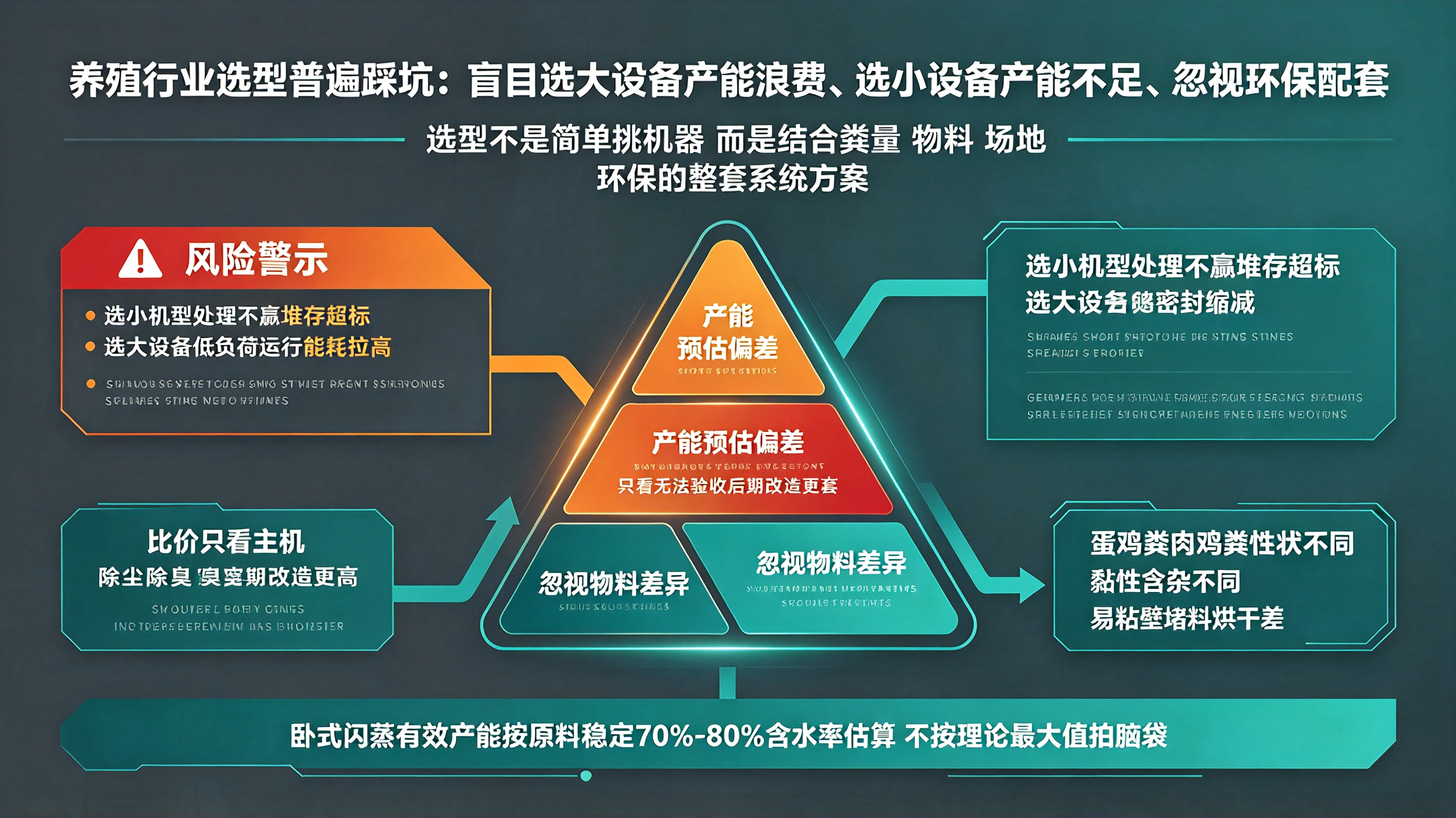
一、养殖行业选型普遍踩坑:盲目选大设备产能浪费、选小设备产能不足、忽视环保配套
鸡粪烘干项目选型三大高频坑,很多养殖场都中招:
1.产能预估偏差:要么高估设备实际产能,选小机型,粪污处理跟不上,堆存超标;要么盲目上大设备,日常粪量不足,设备低负荷运行,单位烘干能耗拉高,投资成本白白浪费。卧式闪蒸标注时产,是原料稳定 70%-80% 含水率前提下的有效产能,不能直接按理论最大值估算。
2.只看主机,忽略环保配套:比价只对比烘干机主机价格,除尘、除臭、密封系统简化缩减。鸡粪烘干过程有粉尘和异味排放,环保配套缺失,项目无法验收,后期改造投入远高于前期选配成本。
3.忽视物料差异:蛋鸡粪、肉鸡粪性状不一样,黏性、含杂量差别很大,直接套用同一款设备方案,投产之后出现粘壁、堵料、烘干效果差等一系列问题。
选型不是简单挑机器,是结合粪量、物料、场地、环保的整套系统方案。
I. Common Pitfalls in Breeding Industry Equipment Selection: Over-sizing for Wasted Capacity, Under-sizing for Insufficient Output, Neglecting Environmental Accessories
Three frequent mistakes plague chicken manure drying project selection:
Inaccurate capacity estimation: Buyers either overestimate the actual throughput and choose too small a unit, leaving manure unprocessed and stockpiles exceeding limits; or blindly purchase oversized equipment. With insufficient daily manure volume, the machine runs under low load, pushing up energy consumption per ton of dried material and wasting capital investment. The hourly throughput marked on horizontal flash evaporation dryers refers to effective capacity under stable raw material moisture of 70%–80%. Do not calculate directly using theoretical maximum values.
Focus only on main unit, ignore environmental supporting systems: Price comparison is limited solely to the dryer host, while dust removal, deodorisation and sealing systems are simplified or cut back. Drying chicken manure generates dust and odour emissions. Missing environmental supporting facilities leads to project acceptance failure. Retrofit costs later will far exceed the extra expense of fitting these components at the outset.
Disregard material differences: Layer manure and broiler manure differ greatly in properties, viscosity and impurity content. Applying the same equipment scheme directly will cause wall adhesion, material blockage and poor drying performance once operational.
Equipment selection is not simply picking a machine; it requires a full system solution combining manure output, material traits, site layout and environmental requirements.
二、核心选型判断维度:蛋鸡/ 肉鸡粪差异、每日粪污产生量、车间场地大小
选型第一步,先摸清自身三个基础条件,再挑选设备:
✅ 蛋鸡粪 VS 肉鸡粪 蛋鸡粪:含钙高、黏性更强,结团严重,更考验主机打散能力,对防粘壁结构要求更高;肉鸡粪:纤维杂质多,毛发、饲料残渣含量高,前置筛分必须做好,防止杂物进入主机磨损转子。
✅ 每日粪污产生量 以养殖场存栏量核算日产鲜粪总量,预留 10%~20% 余量。考虑雨天、集中清粪时段粪量波动,不能按最低粪量选型,避免高峰期处理能力不足。
✅ 车间场地大小 卧式闪蒸成套产线包含主机、热源、除尘除臭、输送料仓,要预留设备安装、检修、原料堆放、成品暂存空间。场地狭小,需要提前调整设备布局,选 择紧凑化成套方案。
II. Core Selection Criteria: Differences between Layer / Broiler Manure, Daily Manure Output and Workshop Space
The first step in selection is to clarify three basic on-site conditions before choosing equipment:
✅ Layer manure vs Broiler manure Layer manure: high calcium content and stronger viscosity, forming heavy clumps. It demands stronger material breaking capacity of the main unit and higher-performance anti-sticking structure. Broiler manure: rich in fibrous impurities including feathers and feed residues. Pre-screening must be properly implemented to prevent debris entering the main unit and wearing the rotor.
✅ Daily manure production Calculate total fresh manure output based on farm inventory and reserve a 10%~20% surplus. Account for output fluctuations during rainy weather and concentrated manure cleaning periods. Never select equipment according to minimum manure volume, to avoid insufficient processing capacity during peak periods.
✅ Workshop footprint A complete horizontal flash evaporation line includes the main machine, heat source, dust & odour removal and conveying silos. Space must be reserved for equipment installation, maintenance, raw material stacking and finished product temporary storage. If the workshop is cramped, adjust layout in advance and adopt a compact integrated solution.
三、卧式闪蒸不同型号时产区间,中小型鸡场、八十万羽以上大型鸡场选型推荐
结合养殖场存栏规模,对应卧式闪蒸机型参考:
·中小型鸡场(80万羽~100 万羽):鲜粪产生量小,可选每天处理80吨卧式闪蒸烘干机组。整套设备占地小、装机功率适中,投资门槛低,满足日常粪污消纳,适合有机肥自用或者本地就近销售。
·中型鸡场(100万~200万羽):推荐每天处理100吨机型。自动化程度更高,可连续运行,粪污处理稳定,是市场上通用性最强的主流配置,兼顾处理能力与项目投资。
·大型鸡场(200万羽以上):粪污产出量大,选用每天处理200吨卧式闪蒸成套产线。全套系统配套 PLC 自动控制,可 24 小时连续生产,可直接对接后端有机肥造粒生产线,实现粪污一体化资源化利用。
提示:选型时一定要以实测日产鲜粪量为准,存栏量仅作为初步估算依据。
III. Hourly Output Ranges for Different Horizontal Flash Evaporation Models, Recommended Options for Small & Medium Chicken Farms and Large Farms above 800,000 Birds
Model recommendations aligned with farm stocking scale:
Small & medium chicken farms (800,000~1,000,000 birds): Low fresh manure yield. A horizontal flash evaporation dryer with 80 tons per day processing capacity is suitable. The full set occupies limited land with moderate installed power and low investment threshold. It meets daily manure disposal needs for on-farm organic fertiliser use or local nearby sales.
Medium chicken farms (1,000,000~2,000,000 birds): Recommended 100 tons per day model. Higher automation supports continuous stable manure treatment. This is the most versatile mainstream configuration, balancing processing capacity and project investment.
Large chicken farms (over 2,000,000 birds): High manure output. Adopt the complete 200 tons per day horizontal flash evaporation line equipped with PLC automatic control for 24-hour continuous production. It can directly connect to downstream organic fertiliser granulation lines to realise integrated manure resource utilisation.
Tip: Selection must be based on measured daily fresh manure yield; stocking quantity serves only for preliminary estimation.
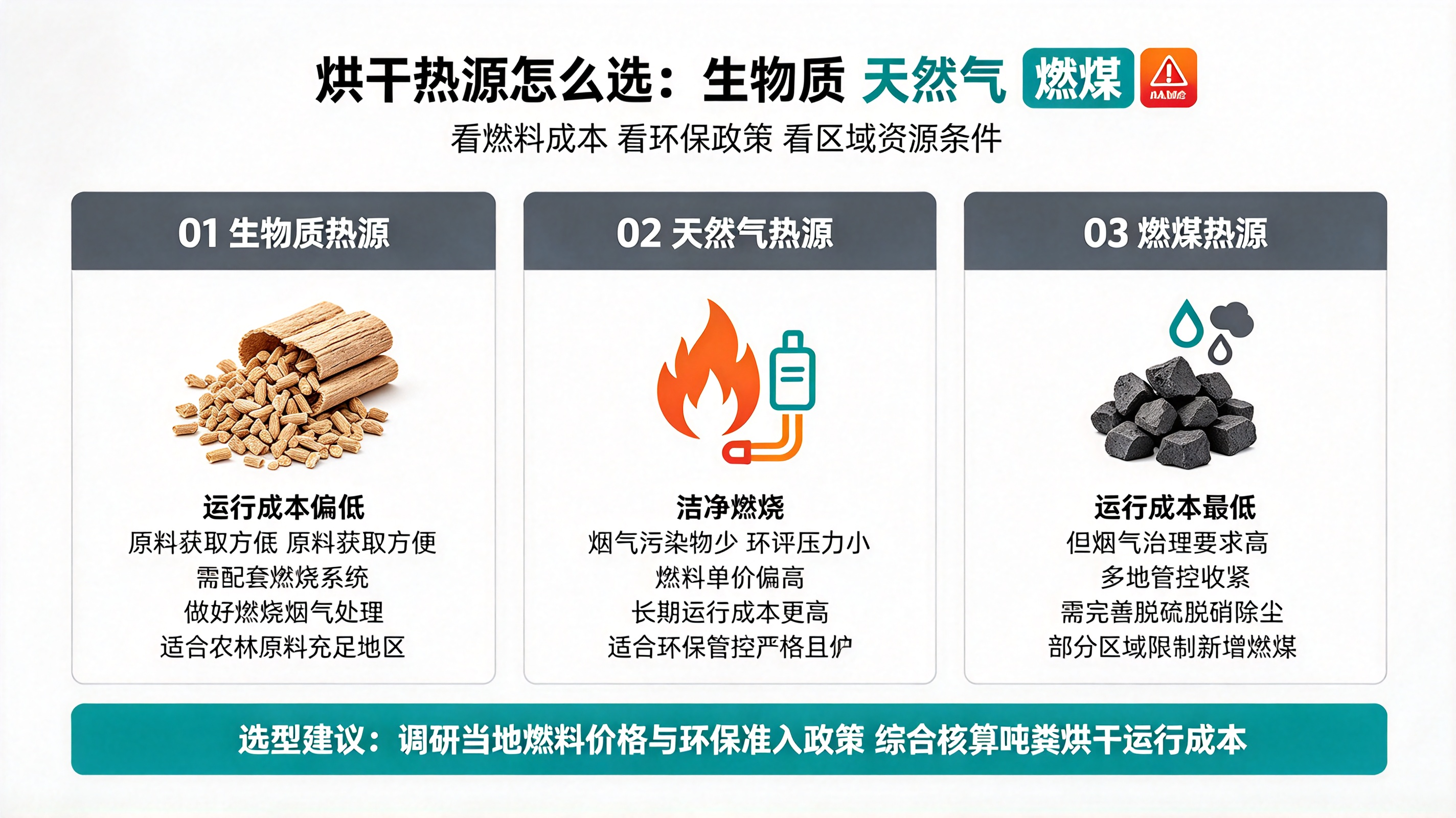
四、热源匹配选型:生物质、天然气、燃煤热源优缺点,结合当地能源成本选择
热源是整套烘干系统能耗核心,不同热源方案成本、环评要求差异明显:
1.生物质热源:以生物质颗粒、木屑为燃料。运行成本偏低,原料获取方便;需要配套燃烧系统,做好燃烧烟气处理。适合农林原料充足地区。
2.天燃气热源:洁净燃烧,烟气污染物少,环评压力小;但燃料单价偏高,长期运行成本更高。适合环保管控严格、天然气供应稳定区域。
3.燃煤热源:运行成本最低,但烟气治理要求高,多地管控收紧,需要配套完善脱硫脱硝除尘,部分区域限制新增燃煤炉,选型前务必确认当地政策。
选型建议:优先调研当地燃料价格、环保准入政策,综合核算吨粪烘干运行成本,再确定热源方案。
IV. Heat Source Matching & Selection: Advantages and Disadvantages of Biomass, Natural Gas and Coal-fired Heat Sources; Choose Based on Local Energy Costs
The heat source is the core factor determining energy consumption of the whole drying system. Different heat source schemes vary significantly in operating costs and EIA requirements:
Biomass heat source: Fuel includes biomass pellets and wood chips. Low running cost and easy raw material access; requires matching combustion system and proper flue gas treatment. Suitable for regions with abundant agricultural and forest raw materials.
Natural gas heat source: Clean combustion with few flue gas pollutants and low EIA pressure. However, fuel unit price is high and long-term operating cost is higher. Suitable for regions with strict environmental supervision and stable natural gas supply.
Coal-fired heat source: Lowest operating cost, yet stringent flue gas treatment standards. Controls are tightening in many regions. Complete desulfurisation, denitrification and dust removal are required. Some areas restrict new coal-fired furnaces. Confirm local policies before selection.
Recommendation: Investigate local fuel prices and environmental access policies first, calculate drying operating cost per ton of manure comprehensively, then finalise the heat source plan.
五、环保配套选配:负压除臭、布袋除尘、喷淋净化系统选配方案
鸡粪烘干尾气含有粉尘与氨气异味,环保配套不能省,按需组合选配:
1.布袋除尘系统:收集烘干尾气中的固体粉尘,是基础标配,保证粉尘达标排放;
2.负压除臭系统:整套产线维持微负压运行,防止臭气从设备缝隙向外溢出,改善车间操作环境;
3.喷淋净化系统:水洗吸收氨气等异味气体,降低尾气臭味,用于排放口深度净化,满足高标准区域环保要求。
环保配套建议:项目前期同步咨询当地生态环境部门排放要求,配套系统一次性规划到位,避免后期追加改造。
V. Environmental Supporting Configuration Options: Negative-pressure Deodorisation, Baghouse Dust Collection and Spray Purification Systems
Tail gas from chicken manure drying contains dust and ammonia odour. Environmental supporting facilities cannot be omitted. Combine and select systems according to requirements:
Baghouse dust collection system: Collects solid dust in drying tail gas; basic standard configuration to guarantee dust discharge compliance.
Negative-pressure deodorisation system: Maintains slight negative pressure across the whole production line to prevent odour leakage through equipment gaps and improve workshop working conditions.
Spray purification system: Scrubs and absorbs ammonia and other odorous gases to reduce exhaust smell. Used for advanced purification at discharge outlets to satisfy high-standard environmental requirements in strict-regulation zones.
Environmental suggestion: Consult local ecological and environmental authorities on emission requirements at the early project stage, and fully plan supporting systems upfront to avoid additional retrofits later.
六、厂房基建、供电、排风配套前置规划要点,减少后期改造投入
很多项目后期大量追加费用,根源是前期基建规划缺失:
1.厂房基建:设备基础要做硬化处理,预留检修空间;原料堆场做好防雨防渗,防止鲜鸡粪雨水渗入,进一步拉高含水率;车间做好通风排风。
2.供电配置:整套烘干主机、引风机、输送、除尘为大功率负载,提前核算总装机容量,匹配变压器。大型产线需要提前对接电力部门评估用电条件。
3.管路布局:热风管道、尾气管道尽量缩短、减少弯头,降低风阻,减少能耗与积料风险。
前期把基建、供电、排风同步纳入方案,大幅降低项目二次改造费用。
VI. Pre-planning Points for Factory Infrastructure, Power Supply and Ventilation to Reduce Later Modification Costs
Extra expenditure in many projects arises from inadequate early infrastructure planning:
Factory building infrastructure: Equipment foundation must be hardened with maintenance space reserved. Raw material yards should be rainproof and anti-seepage to prevent rainwater infiltrating fresh chicken manure and raising moisture content further. Install workshop ventilation and exhaust systems.
Power supply configuration: The dryer main unit, induced draft fan, conveyors and dust removal equipment are high-power loads. Calculate total installed capacity in advance and match transformers. Large production lines require early consultation with power authorities to assess electricity supply conditions.
Pipeline layout: Keep hot air and tail gas pipes as short as possible and minimise elbows to reduce wind resistance, energy consumption and material accumulation risk.
Integrating infrastructure, power supply and ventilation into the initial plan greatly cuts secondary reconstruction expenses.
七、金万泓免费物料试烘+ 现场勘测服务,按需定制成套烘干生产线
每家养殖场粪污性状、场地条件、环保政策各不相同,标准化设备不一定完全适配。金万泓机械可为客户提供现场勘测,实地考察养殖场地、粪污情况、厂房与能源条件;还可提供物料试烘服务,取客户现场鲜鸡粪样品试验烘干,验证烘干效果,测算实际能耗,基于实测数据定制卧式闪蒸成套烘干产线方案。从主机选型、热源配套、环保系统、产线布局,提供一体化项目方案,从源头规避选型风险。
VII. Jinwanhong Free Material Test Drying + On-site Survey Service, Customised Complete Drying Production Lines
Every farm differs in manure properties, site conditions and local environmental policies. Standardised equipment may not be fully suitable. Jinwanhong Machinery provides on-site surveys to inspect breeding premises, manure status, workshop and energy conditions. We also offer material test drying service: collect fresh chicken manure samples from your site for drying trials to verify drying performance and calculate actual energy consumption. A custom horizontal flash evaporation drying line solution is formulated based on measured data.
We deliver integrated project solutions covering main unit selection, heat source matching, environmental systems and production line layout, eliminating selection risks from the start.
结语
鸡粪烘干机选型,核心不是看设备价格,而是匹配养殖场粪量、物料特性、场地条件和当地环保政策。产能预留合理、热源方案择优、环保配套前置规划,才能避免投产之后产能不足、能耗超标、环评卡壳等问题。
如果您正在规划鸡粪烘干资源化项目,不确定机型匹配、热源与环保配套方案,欢迎联系我们获取项目选型方案。
The core of chicken manure dryer selection is not equipment price, but matching capacity to your farm’s manure volume, material characteristics, site conditions and local environmental policies. Reasonable capacity allowance, optimised heat source scheme and advance planning of environmental supporting systems prevent problems after commissioning such as insufficient throughput, excessive energy consumption and EIA rejection.
If you are planning a chicken manure drying resource utilisation project and need guidance on model selection, heat source and environmental supporting schemes, contact us for your custom project selection plan.